
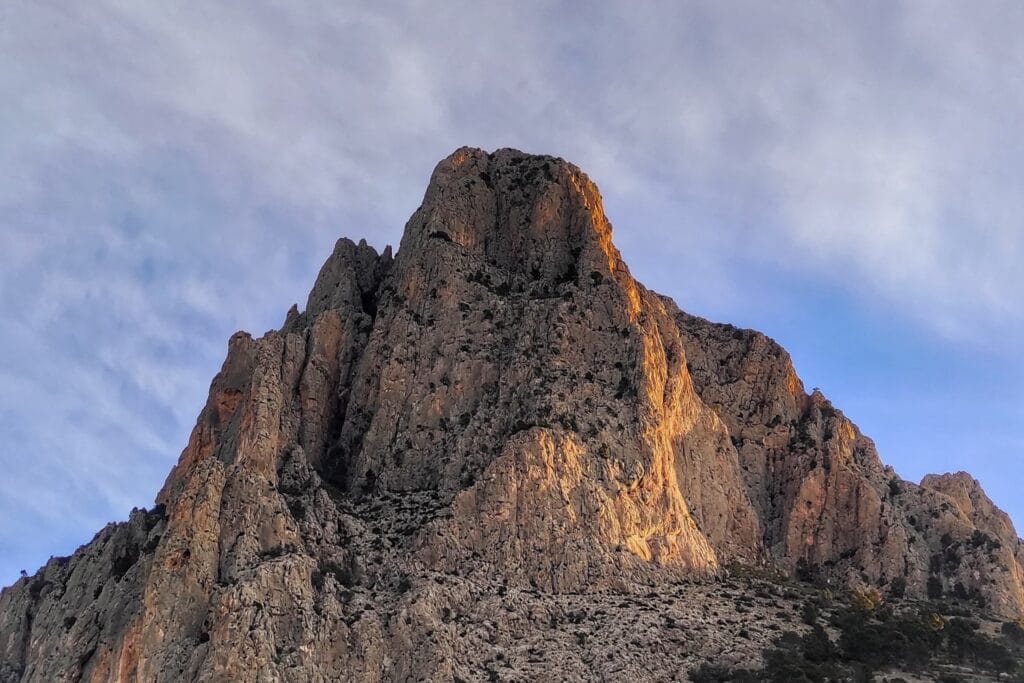
The Puig Campana is one of the walls with the greatest elevation (1,406 m above sea level) and the longest routes in the Valencian Community, one of the meccas of Mediterranean mountaineering. On its west face you find routes of up to 900 metres. Its south face, though shorter, has routes over 400 metres. This is the complete guide to climbing it: what the days are really like, the classic routes with their length and grade, the four zones in detail, and how to do it with a certified local guide.
Long days, real mountains
Climbing the Puig Campana means long activities where you must keep a very close eye on timing, experience and the team’s speed. To put some numbers on the table: approaches of 45 to 70 minutes, descents of 90 minutes, and climbs of up to 8 to 12 hours, above all on the west face. On the south face we are talking about 4 to 8 hours of climbing depending on the team’s experience. In short, these are activities that can reach 14 or 15 hours car-to-car, where you must weigh the hours of daylight (carry a headtorch), the temperature and your intake of water and food. And it can get more complicated still if you do not know the terrain.
Where is the Puig Campana?
The Puig Campana sits in Finestrat, Alicante. This mass of limestone is part of the Prebaetic ranges of the Alicante province. It is a scarce hour from Alicante and roughly two hours from Valencia.
The easiest routes on the Puig Campana
Within the complexity of semi-equipped routes, and in the Puig Campana environment, we could name these as «the easiest»:
- Espolón Central, 430 m, V+.
- Arista Aristóteles + Cresta Pepsi, 350 m, V+.
- Línea Mágica (Aristóteles + Pepsi + Espasa + SW spur), 800 m, V+.
The most popular routes
- Espolón Central, 430 m, V+.
- Julia (+ Espolón Central), 430 m, 6b+.
- Espolón Finestrat + Arista Aristóteles + Cresta Pepsi, 450 m, V+.
- Diedro Gallego, 150 m, 6a.
- Diedros Mágicos + Espolón Elegante, 340 m, 6a+.
- Els Entorns, 700 m, 6a.
- Noi, 900 m, 6b+.
- Diamante, 200 m, 6b+.
- Danza de la Lluvia + Diedro de las Sirenas, 300 m, 6b+.
Most routes here are classic in style, though you can find the odd harder bolted line. In general, on this wall you will use trad gear. That said, you can lean towards better-equipped routes that still need some gear, like Noi on the west face.
Hard routes and challenges
Whether or not we can call them «popular» given the number of repeats, the Campana holds routes of very high quality for different independent reasons: rock quality, the feat of the first ascent itself, the exposure, the complexity. To name a few (leaving many in the pipeline): old routes worthy of this section like Els Entorns and Niño Bravo; more recent lines opened in cold blood like Mundos Paralelos; and some that are simply wonderful, like Virgo (7b, 260 m), You Were Younger (7a, 350 m) and Borderline (6c+, 650 m).
The Mercury trilogy
We would not want to finish without honouring the three routes, the three immeasurable lines left by Javier Martín alongside his no less important rope partners. A legacy that will endure: Virgo (7b, 260 m), You Were Younger (7a, 350 m) and Borderline (6c+, 650 m). This trilogy is characterised by extremely good rock dominated by water pockets, where you make good use of trad gear. Highly recommended for the boldest.
Contact the local professionals directly.
The climbing zones of the Puig Campana
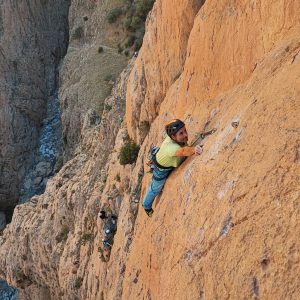
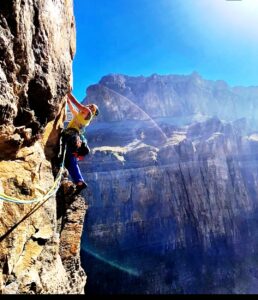
This mass is so big and holds so many routes that climbers have seen the need to divide it into four zones, usually by orientation.
West zone
As mentioned, the west face is where you overcome the greatest elevation, with routes of up to 900 metres running through this tangle of needles, terraces and gullies. On the approach the climber still cannot grasp the immensity of what they are about to enter. Such is the scale that once at the base of the first needle, doubts assault you about whether you are in the right place. Once absorbed by the West, you lose all spatial reference and can only read the topo well, so we recommend good preparation to gather reliable information. If we may give one piece of advice: prefer a topo with a line drawn over a photograph to place the route from the approach, and a detailed hand-drawn topo for the climbing itself.
- Parking: in the dirt pull-outs beside a curve near the PR-CV289.
- Approach: two options depending on the route. If it starts near the Aguja Encantada, approach to its base and scramble up the left-hand gully to find the start. If it is one of the more distant routes, take the PR-CV289 (the Puig Campana circular route) until you are facing the west face, then follow the path that branches towards the wall.
- Descent: once the route is done, walk northeast to reach the Brecha de Roland (yes, named after the Pyrenean one). Follow the cairns to a fixed anchor to reach the huge descent scree, El Carreró. On the way down, keep the «Km Vertical» path to your left; after a long walk it leads to the road, then locate the car park.
- Note: make a good estimate of timing, weather, gear and supplies, and honestly assess the team’s condition and pace on the day. Bailing on this face is complicated.
- Recommended routes: Noi (first ascent and first contact with the wall, fairly equipped), Els Entorns (more adventure), Borderline (a self-protected gem on sublime rock, exiting via GAFE), Mundos Paralelos (experts only: beautiful, hard, exposed, a unique and spectacular line).
Aguja Encantada
A characteristic pyramid-shaped wall of about 200 metres, at the foot of the Puig Campana, separated from it by the Barranc de l’Infern, in the left corner between the south and west faces. It keeps the self-protected style of the Campana, placing bolts only where gear is impossible. The quality of its routes and the rock delight many climbers.
- Parking: dirt pull-outs near a curve on the PR-CV289.
- Approach: the PR-CV289 until an obvious branch to the right leads to the aguja.
- Descent: abseil the Diamante or Espolón Finestrat routes, or make one abseil behind the aguja to walk out via the Barranc de l’Infern.
- Note: for a full day you can do a couple of routes. Highly recommended to combine any route in the sector with Corazón en la Roca, reached by abseil: three pitches starting from a terrace 80 metres below the summit.
- Recommended routes: Espolón Finestrat (obvious and beautiful, the aguja’s first route), Diamante (lovely semi-equipped climbing with a magnificent direct 7a start), Pilar Finestrat (bolder and more exposed, spectacular), Corazón en la Roca (two fully bolted hanging pitches of exceptional rock and climbing).
Southwest zone
The area between the Barranc de l’Infern (including the Arista Aristóteles and Cresta Pepsi, to its left) and the well-known Espolón Central route. The routes here are more classic, obvious lines of low difficulty.
- Parking and approach: as above, via the PR-CV289 to the branch that leads to the Arista Aristóteles.
- Descent: if you reach the summit, follow the red dots towards the east side; after some downclimbing and the odd fixed anchor you reach the scree of the Kilómetro Vertical.
- Note: do not underestimate these routes, dominated by ageing gear, a not-very-obvious line (rarely repeated) and an absence of fixed protection.
- Recommended: the Arista Aristóteles and Cresta Pepsi is one of the most repeated lines on the Puig Campana.
Central zone
The most frequented by climbers: routes like the Espolón Central and the Julia see ascents every week. The quality of the routes and rock leaves nobody indifferent.
- Parking and approach: PR-CV289 to a first branch on the right, marked by two large cairns, leading to the Espolón Central.
- Descent: from the summit, follow the red dots to the east side and the Kilómetro Vertical scree. For routes that stop short of the summit, three abseil lines exist: via Rompededos, via Diada del País Valencià, and where the Julia, Diedro Gallego and Espolón Central meet.
- Recommended routes: Espolón Central (one of the most repeated), Julia (magnificent dihedrals), Danza de la Lluvia + Diedro de las Sirenas (one of the best combinations in the sector), Diedros Mágicos (very aesthetic climbing), Virgo (one of the Mercury trilogy, spectacular rock and movement), You Were Younger (another from the same pack, an impressive line with water pockets).
Full route list on the Puig Campana
West sector: Gafe, Mundos Paralelos, Borderline, El Noi, Chorro-Pomares, Els Entorns, Espolón Agulló-Penalva, Ros-Gregori, La Cholita, Niño Bravo, Montesinos-Botella, Dúo Dinámico, L’Espassa de Sant Jaume, Pandemonium, Matar o Morir, Hermanos de Aguja.
Aguja Encantada sector: Vriksasana, Fisura Neolítica, La Flecha, Orange, Dancing on Crystals, Diedro Edward-Pérez, Pilar Finestrat, Diamante, New Generations, Espolón Finestrat, Talismán-Flamingo Dancer, Corazón en la Roca.
Southwest sector: Arista Aristóteles-Cresta Pepsi, Integral Espolón Sudoeste, Espolón Sin Nombre, Vía de los Manguis, La Normal.
Central sector: Espolón Central, Directísima al Espolón Central, Nueva Edición, The Edge of Time, Julia, Lavapiés, Diedro Gallego, Espolón Edwards, Vía de los Diedros, Viaje en el Tiempo, Danza de la Lluvia-Diedro de las Sirenas, Diada del País Valencià, Bárbara, Europa, Virgo, You Were Younger, Diedros Mágicos, The Wizard, Rompededos, Anglada-Cerdà-Gallego, Espolón Elegant.
For the Puig Campana, the most complete guidebook with the most information is Senderos en la Roca.
The season
October to April is when this side of the Costa Blanca shines: stable weather, cool mornings, sun on the walls. Summer is for the beach. On the Puig Campana especially, the short winter days catch out slow parties every season, so plan route length against sunlight honestly. Fly to Alicante; Finestrat is about an hour away by car.
Why climb the Puig Campana with a local guide
Guided climbing is common on the Puig Campana, where many guides take their clients to enjoy this emblematic wall. And for good reason: this is a serious mountain where route-finding errors cost hours you may not have, the descents are long and the west face is committing. A certified local guide picks the right route for your level and speed, manages the timing and the descent, and turns a potential epic into the great day this mountain can give. If the Espolón Central or your first big multi-pitch is the dream, hire one.
Tell us your plan and climb the Puig Campana with a certified local guide
Useful links
- Climbing guides for the Puig Campana (profiles in Spanish, many speak English)
- Climbing on the Peñón de Ifach, the Puig Campana’s coastal neighbour
- More climbing destinations in Spain