
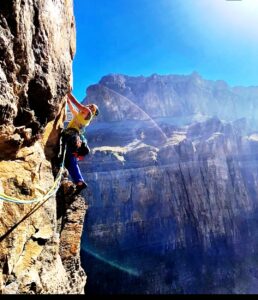
Drive the motorway between Huesca and Sabiñánigo and at some point you will see them in the distance: a row of rock giants that look less real the closer you get. At the foot of these conglomerate towers sits the tiny village of Riglos, and above it rises some of the most distinctive multi-pitch climbing on the planet. The Mallos de Riglos are walls of red sandstone and conglomerate up to 300 metres tall, sculpted by erosion since the Alpine orogeny raised the Pyrenees some 65 million years ago, and climbing here feels like nowhere else: steep, physical and wildly exposed, on rounded cobbles from pebble-size to bigger than your head. Griffon vultures nest on the walls and will glide past you on the upper pitches.

What the climbing is like
Riglos is multi-pitch territory built on «romos»: rounded, sloping holds that reward open-hand strength and calm feet. The modern classics are bolted, steep and pumpy, with long sustained pitches where the difficulty is managing the exposure and saving your arms rather than crimping. The older classic routes mix bolts with traditional gear and demand more mountain sense. Either way, this is not the place for your first multi-pitch: you want solid rope management, efficient changeovers and a cool head for a lot of air under your feet.
The towers and their classic routes
There are over twenty named sectors at Riglos (Firé, Dedo Firé, Castilla, Circo Norte, Norte Pisón, Puro, Sur Pisón, Torreón, Macizo, Los Volaos, Cuchillo, Mallo Frechín, Visera, Del Agua, Mallo Colorado, Aguja Roja, Peña Sola, Circo de Verano and more), but four names dominate every wish list.
Mallo Firé
- Normal al Mallo Firé, 100 m, IV+. The traditional first summit.
- Rabadá-Navarro, 300 m, 6b. The historic king line of the wall, a serious full-day outing.
- Galletas, 220 m, 6b.
El Puro
- Normal al Puro, 240 m, 6b. The freestanding «cigar» is the most photogenic summit in Riglos and one of the most coveted.
Mallo Pisón
- Normal al Mallo Pisón, 110 m, V+.
- Espolón Adamelo + Normal, 280 m, 6a.
- Pany-Haus, 220 m, 6a.
- Murciana, 320 m, 6c+.
- Tucán Ausente, 300 m, 7a.
La Visera
The great overhanging visor holds the steepest famous routes in Riglos:
- Quinta Chimenea, 190 m, 6b.
- Moskitos, 200 m, 6b.
- La Fiesta del Bíceps, 240 m, 7a. Probably the most famous steep jug-haul in Europe.
- Zulú Demente, 240 m, 7b.

The easiest routes: where to start
Many teams take their first Riglos steps on the Normal routes of the Firé or the Pisón, but there is a friendlier laboratory a stone’s throw from the main towers: the Aguja Roja. Its introductory bolted routes of just over 100 metres are the ideal place to make friends with the strange conglomerate before committing to the big walls:
- Normal a la Aguja Roja, 100 m, IV+.
- Edil, 110 m, V.
Easy grades do not mean casual outings: even here you need your multi-pitch fundamentals, from building belays to managing the descent.
Contact the local professionals directly.
When to go
Spring, autumn and winter are the seasons, and the area claims around 300 sunny days a year. The south-facing walls turn cold clear days into perfect climbing days, and make summer brutal. Watch route length against daylight honestly: the big lines are serious outings and slow parties get benighted here every year. And a Riglos particular: check for vulture droppings below your intended line before you rack up. The colony is part of the experience.
Getting there and local logistics
Riglos sits about 45 minutes northwest of Huesca and around an hour and 20 minutes from Zaragoza, whose airport connects through Madrid and Barcelona. The village is tiny and the walls start at its last house, one of the shortest approaches in big-wall climbing. For complete route documentation the local guidebook is the well-known Riglos Vertical; buying it also supports the local equippers who maintain these routes.
Ask about upcoming courses and guided days with certified guides.
Climb Riglos with a certified guide
If the towers call to you but the exposure, the route-finding or the gear give you pause, this is exactly the kind of place where a certified local guide changes everything. You climb the tower, the guide manages the rest: the right route for your level, the belays, the timing and the descent. Confident seconds with basic multi-pitch experience summit the Puro or ride La Fiesta del Bíceps with a guide years before they could lead it themselves.
Tell us your level and dates, and climb a Riglos tower with a local guide
Useful links
- Climbing guides in Riglos (profiles in Spanish, several guides speak English)
- More climbing destinations in Spain