
Climbing in Valencia, on Spain’s eastern Mediterranean coast, is one of Europe’s worst-kept secrets: a province that holds Chulilla, a world capital of sport climbing, plus dozens more areas spread between the sea and the interior. Valencia climbing means limestone almost every day of the year if you pick your orientation well, and within an hour of the city you have more rock than you could climb in a lifetime. This guide covers every climbing area in the province, with its grades, its best season, its approaches and, most importantly, the access restrictions you need to know before you go.

Quick facts
- Dominant rock: limestone (with rodeno sandstone in the Garbí bouldering)
- Disciplines: sport climbing (the majority), multi-pitch, bouldering and deep-water soloing
- Star area: Chulilla, one of the great sport-climbing destinations in the world
- Reference areas: Chulilla, Buñol, Ontinyent, Gandía, Alzira, Montesa, Bellús, Gestalgar
- Season: all year if you choose orientation; winter is the high season
- Close to the city: Torrent (30 min), Vilamarxant (30 min), Buñol and Cheste (35 min)
- Watch out: several areas close for bird nesting. Check the regulations section
Valencia has a rare stroke of luck. While half of Europe puts the rope away in November, the good season starts here: the winter sun hits the south-facing walls, the afternoons are long and the limestone bites. That is why the Turia canyon in Chulilla fills with vans carrying number plates from all over the continent between October and May.
But reducing climbing in Valencia to Chulilla would be a huge mistake. The province has an astonishing density of areas: gorges with hundreds of routes in Ontinyent, high-performance caves in Gandía, multi-pitch walls in Gestalgar and Alzira, perfect beginner schools in Montesa, sandstone bouldering at El Garbí and even deep-water soloing over the sea in Cullera. This guide covers them all.
The climbing areas of Valencia at a glance
This is the big picture of the main areas, so you can choose according to what you are after, how far you want to drive and what time of year you are going.
| Area | Town | From Valencia | Discipline | Routes | Grades | Best season |
|---|---|---|---|---|---|---|
| Chulilla | Chulilla | 1 hr | Sport | Over 1,000 | 5 to 9a | Autumn to spring |
| Buñol | Buñol | 35 min | Sport and bouldering | 118+ and around 200 boulders | 4+ to 8c+ | All year |
| Ontinyent | Ontinyent | 1 hr 15 | Sport | 215 to 240 | V to 8a+ | All year |
| Gandía | Gandía | 1 hr | Sport | Bovedón around 50 | Up to 8a | Winter |
| Alzira | Alzira | 50 min | Sport and multi-pitch | Around 150 | 4 to 7b | Winter |
| Montesa | Montesa | 50 min | Sport | 100 to 159 | 4 to 7a+ | All year |
| Bellús | Bellús | 1 hr | Sport | No reliable figure | 4 to 8b | All year |
| Gestalgar | Gestalgar | 1 hr | Multi-pitch | No reliable figure | V to 8th | Spring and summer |
| Chera | Chera | 1 hr | Sport and bouldering | Over 120 | No reliable figure | All year |
| El Garbí | Segart | 30 min | Bouldering | Around 80 boulders | Up to 8a+ | Autumn to spring |
| Torrent | Torrent | 20 min | Sport | 17 | Up to 6th | Winter |
| Vilamarxant | Vilamarxant | 30 min | Sport | 10 to 25 | 4c to 6b | All year |
| Cullera | Cullera | 45 min | Deep-water soloing | No reliable figure | 5b+ to 6b | Summer |
Route counts vary between sources, so treat them as a guide. For the fine detail, nothing beats an up-to-date printed guidebook.
Chulilla, the crown jewel
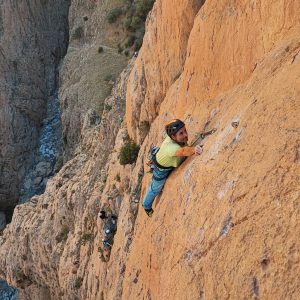
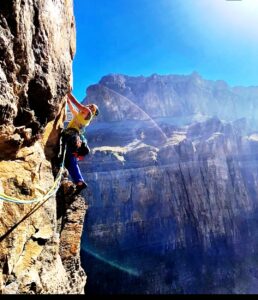
If climbing in Valencia is known around the world, it is because of Chulilla. An hour from the city, the river Turia carves a canyon roughly four kilometres long with walls of up to 160 metres of grey and orange limestone, and that is where over a thousand routes are concentrated, most of them between 6c and 8a, with that vertical crimping-and-endurance style that either hooks you or drives you mad.
Why it is so famous. Volume, quality and season. While northern Europe freezes, here you climb in a T-shirt in the sun. Chulilla has earned its place among the great Spanish sport-climbing destinations, alongside Siurana and El Chorro, and the village feels it: its population multiplies by five at weekends and holidays, with a high season running from October to May, the exact opposite of the rest of Valencia’s tourism.
Its sectors. The Chulilla map includes names any climber recognises: Sex Shop, Pesadilla, Oasis, Balcón, Competición, Cherales, El Muro de las Lamentaciones, Tierra de Nadie, El Romallar, Los Directos and the Muro de Enfrente, among many others.
Routes that have made history:
- Alien Sex Friend, by Pedro Pons, 1990. The first 8th grade of the crag.
- Siempre se puede hacer menos, 70 m, 8c+. Slovenian Klemen Bečan made the first ascent on sight on 30 December 2014, the hardest of his career up to that point.
- Chulilla Experience, a horizontal big wall of 1,036 metres along the canyon, with a maximum of A3, opened by David Palmada «Pelut» and Alex Pastor after four years of work and finished in August 2022.
- Las Reglas del Juego, its 1996 forerunner, some 550 metres of horizontal crack with almost no bolts, by Vicente Cervera and Jesús García.
The village, the castle and the pools. Chulilla is a spa town of around 710 inhabitants perched above the canyon, crowned by a castle of Moorish origin that was once used as a prison for clergymen on the orders of San Juan de Ribera. Below, the Turia forms pools and the famous Ruta de los Pantaneros runs through the canyon with its hanging bridges.
And here is a detail almost nobody tells you: that path was not born as a tourist trail. It was opened by the workers who built the Loriguilla dam between 1955 and 1965, a project that forced the relocation and flooding of two entire villages, Loriguilla and Domeño. The workers who went on foot crossed the river by two hanging bridges, until the great flood of 1957 swept them away.
Contact the local professionals directly.
The best climbing areas in the province
Beyond Chulilla, this is what you have.
Buñol, the most complete and the closest
Just 35 minutes from Valencia, the dry canyon of the Malacara range gathers more than 118 routes on limestone and around 200 boulders, with grades from 4+ up to 8c+. Its great virtue is that the canyon faces every direction, so you can climb 365 days a year: in winter, the sunny sectors (Carcalín, Corral de Cabras, Muro de Hierro); in summer, the shaded overhangs (Sueños de Verano, Criaturas).
A local warning: there is such a thing as the «Buñol grade». In the Carcalín zone it is worth adding half a grade to a grade and a half to whatever the topo says, so do not panic if the 6b shuts you down.
Ontinyent, second by volume
The Barranc de l’Avern, next to the well-known Pou Clar, is the largest concentration of routes in the province after Chulilla: between 215 and 240 routes across more than a dozen sectors, on excellent-quality limestone, with grades from V to 8a+ and walls up to 40 metres. It has south-facing sectors for winter and north-facing ones for summer, so the season is very long. And the approach runs from zero to fifteen minutes.
Gandía, high performance
Marxuquera and above all the Bovedón are the reference if you want to really pull hard: top-quality orange limestone with tufas and streaks, overhanging caves and some of the hardest routes in the province, between 7b and 8a. Marxuquera faces south, so it is a winter zone; the Bovedón works almost all year except in summer, when heat and humidity make it unclimbable.
Alzira, multi-pitch by the sea
The Tallat Roig, in the La Murta area, gathers around 150 routes on heavily pocketed limestone with excellent friction, south-facing (a winter zone) and a wall that at its highest exceeds 60 metres, allowing outings of up to three pitches in the Big Wall sector. Fifteen minutes on foot from the parking and with sea views. Nearby, on the same range, the Solana de la Casella offers classic climbing of 90 to 100 metres for the coldest months.
Montesa, the beginner school par excellence
The Mola de Montesa is probably the busiest school in the province, and for good reason: between 100 and 159 short routes (10 to 15 metres) on orange limestone, with friendly grading, excellent bolting, a flat base and an approach of under five minutes from the car park beside the castle ruins. The Tormo Gros also has faces in all four cardinal directions, so there is always something in the sun or the shade.
Bellús, quality and variety
The Estret de les Aigües combines three sectors with complementary orientations (Barranco Fondo, the Cova Petxina and El Altet), grades from 4 to 8b and excellent limestone. The Cova Petxina, with a one-minute approach, is one of the most recommended beginner areas in the province.
Gestalgar, the summer option
This is home to the most accessible multi-pitch routes in the province, from 130 to 210 metres, with sectors for both beginners (Picnic, V to 6th) and advanced climbers (Cueva, 7th and 8th). Its trump card is summer: plenty of shade, a virtually non-existent approach (you park next to a bridge at the foot of the routes) and the river for a swim afterwards.
Chera and Sot de Chera
More than 120 routes across five sectors, with its own guidebook and two bouldering zones, a stone’s throw from Chulilla. It has beginner sectors (Frankenstein, Cherales) and others with excellent rock and hard routes (Antenas). This is also where you find the Risco del Fraile, a 35-metre crag that is pure founding myth of Valencian climbing, today with regulated access (see regulations).
El Garbí, the province’s bouldering
In Segart, within the Serra Calderona and just 25 kilometres from Valencia, there are around 80 boulders of white rodeno sandstone of great quality, with difficulties up to 8a+. Anyone who has been to Albarracín will recognise the rock instantly. The reference sectors are El Pino and El Monumento.
Climbing near Valencia city
If you are short on time, these are the areas within 40 minutes:
- Torrent (Calicanto), 20 minutes and 10 to walk in. 17 beginner routes up to 6th, sun all day, ideal in winter.
- Vilamarxant (La Cantera), 30 minutes. A reclaimed disused quarry, 10 to 25 slab routes from 4c to 6b, with parking at the foot of the wall.
- El Garbí (Segart), 30 minutes. The home bouldering.
- Buñol, 35 minutes. The best balance of proximity and quality.
- Cheste (El Cuchillo), 35 minutes and 2 to walk in. Around thirty easy, very well-bolted routes, perfect for starting out. Note: the DANA storm of October 2024 destroyed the car park and the lower part of the approach, so you have to park higher up.
- Peñas de Guaita (Puçol), 35 minutes. More historic than sporty, but it is the classic old-school crag of Valencia.
Where to start climbing in Valencia
If you are taking your first steps on rock, these are the best options: Montesa (the most recommendable, for its bolting and friendly grades), Cheste, Torrent, Vilamarxant, the Cova Petxina at Bellús and the Picnic sector at Gestalgar. All of them have easy routes, good bolting and short approaches.
An honest piece of advice: rock is not a climbing gym. Even if the route is easy, it pays to make your first outing with someone who knows how to build belays, manage the lower-off and read the wall. That is the difference between getting hooked and getting a scare.
Multi-pitch, trad and deep-water soloing
Valencia is not only single-pitch sport climbing:
- Gestalgar, 130 to 210 metres, the multi-pitch reference.
- Alzira (Tallat Roig, Big Wall sector), up to three pitches, and the Solana de la Casella, a 90 to 100 metre classic.
- Chelva (Pico del Remedio), four bolted routes of around 100 metres on the east face, at 1,000 metres of altitude.
- Xeresa (Peña Negra), a 120-metre north face with routes of up to four pitches, from 6a to 7b+, and full shade in summer.
- Loriguilla (Pared de los Tubos), up to four pitches (mind the seasonal closure).
- Simat de la Valldigna (Cueva Patricio), a three to six pitch classic.
- Cullera (Cova del Dragut), the province’s deep-water soloing, from 5b+ to 6b, falling into the water over a sandy bottom. A summer activity.
When to climb in each area
The great advantage of Valencia is that there is always something in condition:
- Winter (the high season): Chulilla, Gandía (Marxuquera), Alzira, Torrent, Peñas de Guaita and the sunny sectors of Buñol and Ontinyent.
- Spring and autumn: almost everything, including the Garbí bouldering.
- Summer: Gestalgar (shade and river), Xeresa (north face), Corbera (shady side), the shaded overhangs of Buñol, the north sectors of Ontinyent and the deep-water soloing at Cullera.
- All year: Buñol, Montesa and Bellús, thanks to their variety of orientations.
Access rules and restrictions: read this before you go
This is the section that saves the most grief. Several areas in the province have closures for bird nesting or access problems, and turning up at a closed area harms the whole climbing community:
- Andilla (Cerro las Cabras): closed to protect the Bonelli’s eagle, with reports of environmental disturbance. Climbers are asked not to visit the area until further notice.
- Requena (Atrafal): banned from 1 January to 30 June for golden eagle nesting.
- Loriguilla (Pared de los Tubos): closed from January to July for nesting.
- Chera (Risco del Fraile): access regulated from 1 January to 30 June, by agreement between the town council, the natural park, the local club and the federation.
- Xàtiva (Penya Roja): no climbing in May and June.
- Hoces del Cabriel (Cuchillares de Contreras): sport climbing is banned throughout the natural park; trad only in specific zones and with authorisation.
- Gandía (Marxuquera): part of the area is on private land, with access problems.
- Cheste: car park and approach damaged by the DANA storm of October 2024.
Regulations change. Before heading out, check the up-to-date information from the federation and the access-regulation portals, and always respect local signage.
A bit of history
The early days: hemp ropes and tyre-tread soles
Modern Valencian climbing begins in the post-war years. In 1946 the Centre Excursionista de València was founded and, a year later, the Unidad de Guías Montañeros, which took off for a very concrete reason: it lent gear for free to youngsters without means. People climbed with hemp ropes, home-made pitons, wooden wedges and sandals with truck-tyre soles.
The key dates come thick and fast: in 1951, Enrique Espí and José Bernet made the first great Valencian ascent on the Naranjo de Bulnes; in 1958 the Valencianos route was opened on the Peñón de Ifach; in 1963 the Valencian federation was born. And the first women appear soon after: Palmira Calvo in 1952, and Maruchi Cisneros and Maribel Barberá shortly after, the first documented Valencian women climbers.
The oldest crag in the Valencian Community is Peñas de Guaita, with its first documented route on 23 September 1951. That Centre Excursionista, after seven decades and expeditions to Everest and Nanga Parbat, closed its doors on 28 February 2017.
Chulilla: the village that bet on climbing
The modern history of Chulilla even has a birth date: November 2010, when the magazine Desnivel published a feature titled «Redescubrir Chulilla», written by Pedro Pons, the crag’s main route-equipper. A detail almost nobody knows: Pons was Bouldering World Cup champion in the year 2000, with wins in Millau, Munich and Grenoble. The man who placed the bolts won a World Cup.
And the most remarkable part: the village paid for the routes. The regional tourism department put in 30,000 euros between 2009 and 2010 to open 48 routes on the Muro de Enfrente, and in 2011 it approved 268,000 euros of EU FEDER funds for infrastructure, including rebuilding the Pantaneros path. As one town technician summed it up: «climbing is what sets us apart». Rarely do you see so clearly how a sport can revive a village.
Chulilla has had its scares too. The fire of September 2012 burned 5,500 hectares, but the flames moved away from the Turia gorges: of the roughly 700 routes there were at the time, only about 50 were affected. In Alcublas, on the other hand, that same summer all 200 routes of its guidebook burned.
La Calderona and its legend
The range that rises above Valencia, home to the Garbí bouldering, owes its name to a gully at its southern end, not (as the legend claims) to María Inés Calderón, the actress and lover of Philip IV who supposedly ended up as a bandit around there. The story is pretty but does not hold up: she died in Madrid in 1678. What is true is that the range was a refuge for bandits and moriscos for centuries, hence the popular saying: «to steal, off to La Calderona».
Indoor climbing: Valencia’s gyms
When it rains, or midweek, the city has a good range of climbing gyms for training and for getting started. We cover them in our dedicated guide to climbing gyms in Valencia (in Spanish), with opening hours, prices and what each one offers.
Frequently asked questions
Where can you climb near Valencia?
The areas closest to the city are Torrent (20 minutes), Vilamarxant and the Garbí bouldering in Segart (30 minutes), and Buñol and Cheste (35 minutes). Buñol offers the best combination of proximity, route volume and quality.
What is the best climbing area in Valencia?
Chulilla, without question, for volume (over a thousand routes) and quality, and it is a world reference. If you want something closer and more varied, Buñol; for volume, Ontinyent; and for difficulty, Gandía.
Where can I start climbing on rock in Valencia?
Montesa is the beginner school par excellence, with short routes, friendly grading and a minimal approach. Cheste, Torrent, Vilamarxant and the Cova Petxina at Bellús are also good options.
When is the best time to climb in Valencia?
Winter is the high season, especially in Chulilla and the south-facing areas. In summer you need to seek shade: Gestalgar, Xeresa, Corbera or the overhangs of Buñol. And areas like Buñol, Montesa and Bellús work all year.
Are there multi-pitch routes in the province of Valencia?
Yes. Gestalgar (130 to 210 metres) is the reference, and there are also multi-pitch outings in Alzira, Chelva, Xeresa, Loriguilla and Simat de la Valldigna.
Is there deep-water soloing in Valencia?
Yes, at the Cova del Dragut in Cullera, with grades from 5b+ to 6b and a sandy bottom. It is a summer activity.
Is Montanejos part of Valencia?
No. Montanejos, with around 1,300 routes, is the largest crag in the Valencian Community, but it belongs to the province of Castellón. It is well worth the trip anyway. See our Montanejos climbing guide.
Are there any closed or regulated areas?
Yes, and it is worth checking before you set off. Andilla is closed until further notice; Requena, Loriguilla, Chera and Xàtiva have seasonal closures for bird nesting; and in the Hoces del Cabriel sport climbing is banned.
Climbing in Valencia with a certified guide
The province of Valencia holds a lifetime of climbing, but moving around it with judgement (knowing which area is in condition for the month, which sectors are regulated, which routes suit your level) is what separates a great day on the rock from a wasted one. And if you are starting out, the difference is even bigger.
On this page you can get in touch directly with certified guides who work in Valencia and across the whole Valencian Community, and see their climbing courses, guided outings and activities. They will take you to the right area at the right time, with the gear and the technique you need.
Tell us your plan and climb in Valencia with a certified local guide
Useful links
- Climbing guides in Valencia (profiles in Spanish, many guides speak English)
- Montanejos climbing guide
- More climbing destinations in Spain