Margalef Climbing Guide 2026: Sectors, Routes, Access Booking and Trip Planner
Climb and learn with a qualified local guide Tell us your plan →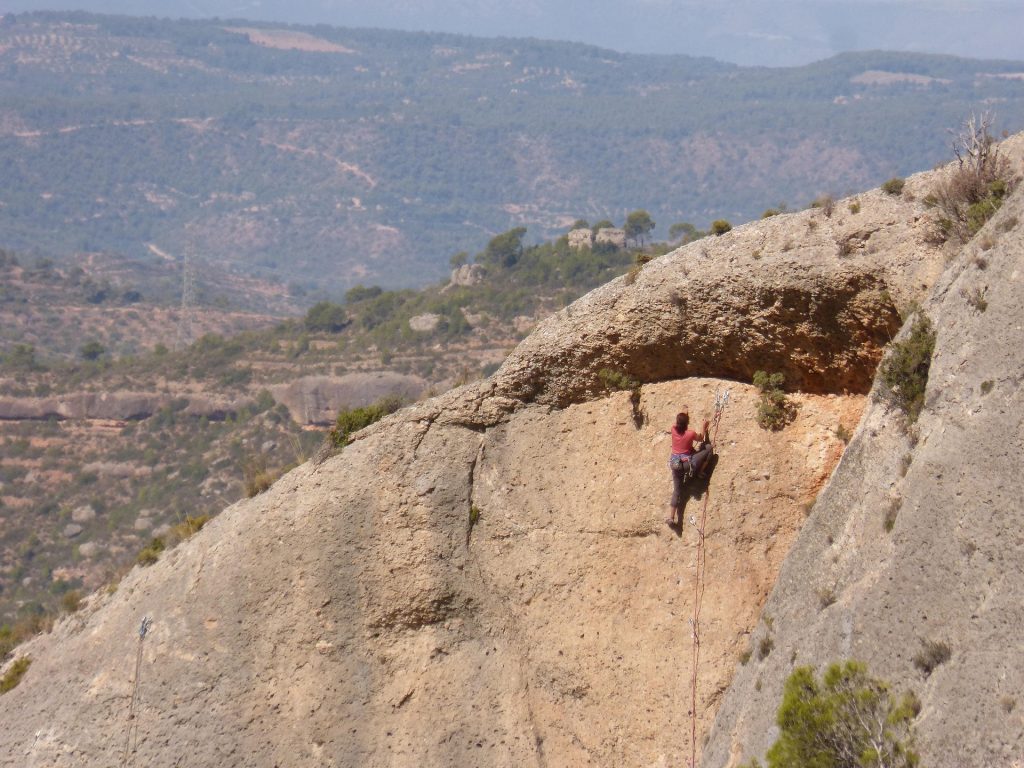
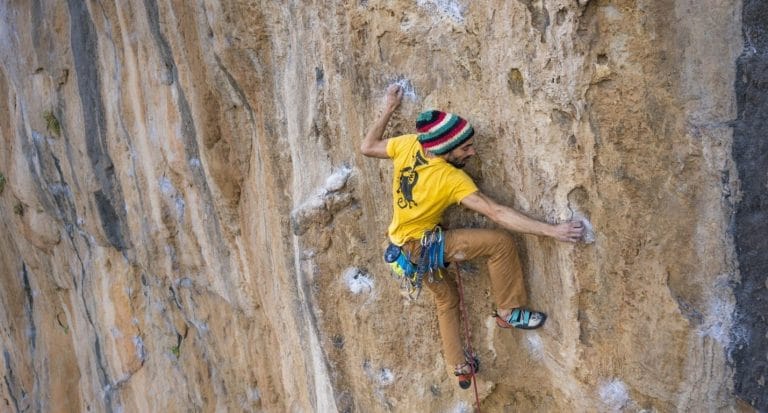
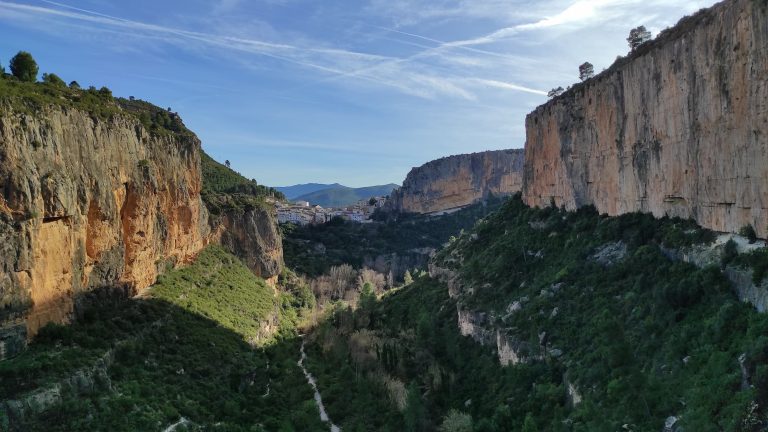
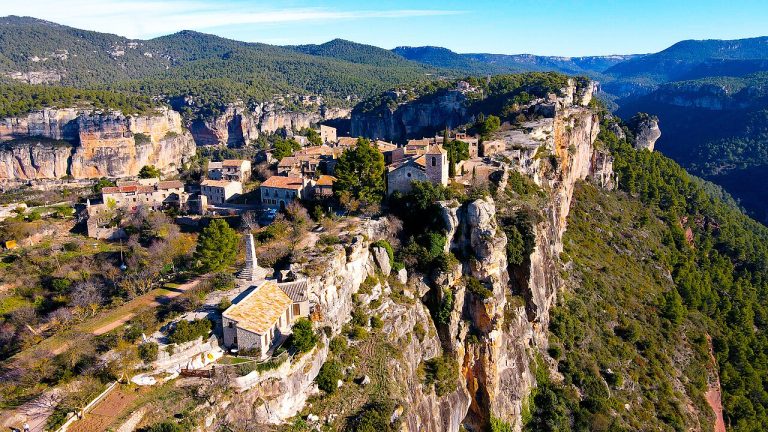
Margalef is a sport-climbing destination known to climbers around the world, and it climbs unlike most Spanish crags. Instead of limestone you get conglomerate: a wall of small, rounded pebbles cemented together, full of one-, two- and three-finger pockets, tufas and steep caves. There are more than 1,800 routes in about 95 sectors, from grade 4 to 9b+, plus a proposed 9c climbed in March 2026, all around a village of just over a hundred people in the Priorat wine region of Tarragona, in Catalonia. Since 14 October 2025 there is one thing every visitor must know before driving in: the two main climbing areas have barriers, and you need an online booking and €5 per vehicle per day. This guide explains the booking step by step and everything else you need for a first trip.
Contents34 sections
- Climb here with a qualified guide
- Margalef at a glance
- Is Margalef right for you?
- The 2025 access rules: booking and €5 per car
- The natural park: zoning, nesting and closures
- When to go, month by month
- Conglomerate: what the rock is and how it climbs
- Sun and shade: choosing your sector
- The six climbing areas at a glance
- Espadelles: the winter star
- Pantano: Laboratori and the beginner sectors
- Sant Salvador, Ermita and Finestra
- Catedral and Comaclosa: the long, hard area
- Taverna and Cova d’en Ros
- Every sector in Margalef, with grades
- French grades, in plain English
- Which sectors for your grade
- Best routes by grade
- The legendary routes: 9a and harder
- A short history of climbing in Margalef
- Getting to Margalef
- Where to stay, legally
- Food, supplies and shops
- Rest days and things to do
- Nearby crags for a longer trip
- When it rains
- Safety, rescue and gear
- Etiquette and local rules
- Practical information for international visitors
- Trip plans: 3 days, 1 week and 2 weeks
- What to pack, by season
- Guidebooks and topos
- Plan your trip with qualified guides
- Frequently asked questions about climbing in Margalef
Climb here with a qualified guide
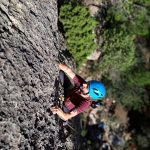
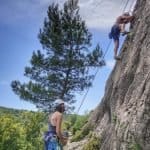
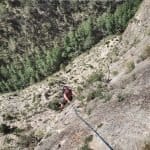
Margalef is easy to love and hard to read on a first visit. There are dozens of sectors, the sun moves fast across walls that face every direction, the grades are often stiff for newcomers to pockets, and the access rules changed in 2025. A qualified guide who knows Margalef well can choose the right sector for the day, the weather and your grade, and can teach you how to climb conglomerate efficiently. Qualified guides who cover Margalef and the rest of the Priorat are available through Destino Climbing, for a single day or a multi-day course.
Margalef at a glance

| What | Details |
|---|---|
| Where | Margalef de Montsant, in the Priorat district of the province of Tarragona, Catalonia, northeast Spain. The village sits at 379 m, and part of its land is inside the Serra de Montsant Natural Park |
| Nearest airports | Reus (71 km, about 1 h 20 by road, mostly a summer-season airport) and Barcelona El Prat (157 km, about 2 h 20) |
| Rock | Conglomerate: small rounded pebbles cemented together, often coated with a hard tufa skin |
| Style | Single-pitch sport climbing, vertical to overhanging; stamina on the walls, bouldery power in the caves. Most routes are about 20 m |
| Routes | More than 1,800 in about 95 sectors (counts range from about 1,500 to 1,960 depending on how sectors are grouped) |
| Grades | From 4 to 9b+, plus a proposed 9c. Grade 7 is the most common; easy routes are a small minority |
| Best season | October to March on the sunny walls; spring and summer on the shady, windy ones |
| Access by car | Online booking and €5 per vehicle per day for the Sant Salvador and reservoir (Embassament and Espadelles) car parks, since 14 October 2025 |
| Overnight rules | No camping, sleeping in vehicles or fires inside the protected area; stay in the village or nearby |
| Rope | 60 m covers most routes and 70 m is a safe choice; 80 m for Cabernet and the 40 m lines at La Catedral; check each route’s length on the tallest walls |
| Icon | Racó de la Finestra, home of Perfecto Mundo (9b+) and Café Colombia (proposed 9c) |
Is Margalef right for you?
It is a very good fit if you:
- climb comfortably in the 6s and 7s and want a huge choice of short, intense routes;
- enjoy steep rock, pockets and tufas, and want to work on finger strength and stamina;
- want to climb in winter in the sun, or in summer in the shade, a short drive from the village;
- like quiet villages, wine country and self-catering.
Think twice if you:
- climb below 6a and want a big choice of easy routes: there are some good beginner sectors, but they are few compared with the size of the area;
- want long multi-pitch routes or trad climbing: Margalef is almost entirely single-pitch sport climbing;
- plan to come without a car: public transport to the village is minimal;
- were hoping to sleep in a van at the crag: overnight stays inside the protected area are banned.
An honest note on grades. Pocket climbing is a skill of its own. Many visitors find the first days humbling, especially if they come from limestone or from indoor walls. Start a grade or two below your usual maximum and build up.
The 2025 access rules: booking and €5 per car
This is the change that affects visitors most, and many older topos and websites do not mention it. The town council announced it in October 2025, and since 14 October 2025 motor-vehicle access to the two main climbing areas is controlled by barriers:
- Sant Salvador, the track from the village towards the Sant Salvador hermitage (Sant Salvador, Ermita and Racó de la Finestra sectors);
- Àrea Embassament, the road to the reservoir, which serves Espadelles and the sectors along the reservoir road (Pantano, Taverna, Catedral and Comaclosa).
The council took the decision, with the natural park’s approval, to reduce the impact of the crowds. Climbing itself is still allowed, and no sector was closed because of the new system.
How to book, step by step
1. Choose your car park. Decide the night before whether you are going to Sant Salvador (Sant Salvador, Ermita and Racó de la Finestra) or to the reservoir road (Espadelles, Pantano, Taverna, Catedral and Comaclosa). For Cova d’en Ros and the outlying sectors, or if you are unsure which car park serves a sector, check with the town council which car park and booking you need before you go.
2. Book online before you drive up. The booking portal is parkingsmargalef.com, available in Catalan, Spanish, English and French. It links to an external booking and payment platform, with one booking link for each car park. Before you pay, check that the link you follow is the one for the car park you want.
3. Pay €5 per vehicle per day. The same price applies to cars and vans at both car parks. Registered residents of Margalef park free all year.
4. Keep your booking code. You need the booking and its code to get through the barrier. Save it on your phone and take a screenshot, because mobile coverage can be patchy.
5. Arrive within the opening hours. Sant Salvador opens at 4:00 and the reservoir area at 5:00. Both close at 23:59.
6. Leave before 23:59. After that time the barriers stop working and you cannot drive out until the next day. There is no on-site service or phone number for that situation, so keep an eye on the clock on long project days.
Moving between the two car parks
One €5 payment covers both car parks on the same day, but not automatically: if you leave the first car park that day and want to climb in the other area, you make a second booking there, free of charge, if spaces remain. It comes with a new code.
Vans, motorhomes and overnight stays
Vans and motorhomes are accepted (check which car park suits your vehicle when you book). The booking is for parking only: it does not allow camping, sleeping in the vehicle or lighting a fire. See the section on where to stay for the legal options.
Fire risk days
On days of very high fire risk under Catalonia’s forest-fire plan (the Pla Alfa), the car park spaces may show as unavailable and bookings can be blocked. In summer and early autumn, check the day’s Pla Alfa alert before you set off.
Walking or cycling in
The barriers are designed for motor vehicles. If you plan to walk or cycle in, check the current rules with the town council before you go.
Busy days
Spaces are limited. Book early for Easter and the 1 November long weekend, the busiest days of the year, and for other Spanish public holidays.
Contacts: Ajuntament de Margalef (town council), Plaça de Sant Miquel 15, +34 977 819 167, aj.margalef@altanet.org; the parking office answers on weekdays from 9:00 to 10:00.
The natural park: zoning, nesting and closures
Roughly half of Margalef’s municipal land lies inside the Parc Natural de la Serra de Montsant. The park divides its cliffs into three climbing zones, set out in a map approved on 19 November 2020:
| Zone | What it means |
|---|---|
| Free zone | Climbing allowed all year. New routes need prior notification to the park |
| Conditional zone | Climbing allowed only from 15 July to 31 December. New routes need prior authorisation |
| Prohibited zone | No climbing and no new routes |
On the park’s official map, the Margalef climbing areas (the reservoir and its surroundings, Sant Salvador and nearby walls) are in the free zone. The conditional zone is a small strip of cliffs above La Morera de Montsant, on the other side of the massif. Even so, birds such as golden eagles, Bonelli’s eagles, vultures, Egyptian vultures and swifts nest in the area, and temporary restrictions for wildlife can appear. Before every trip, check the park’s current calendar and notices, and follow any sign at the crag: the sign on site always takes priority.
- Natural park office: +34 977 827 310; pnmontsant@gencat.cat.
Sectors on private land
Several sectors in the Pantano, Taverna and Catedral areas stand on private land and may have access restrictions: Can Verdures, Can Torxa, Can Llepafils, Totxo Poruc, Can Gueli, Can Net, El Tobogán, Totxo del Vi and Can Regino. Can Torxa and Can Llepafils in particular may currently be off limits. Check the current status with the town council before climbing on any of these sectors, and if a sign at the crag says no, respect it. This guide keeps those sectors out of its itineraries. Tenebres Extensió and Margalwest may also have access issues: check their current status with the town council before you go.
When to go, month by month
Margalef is a year-round destination if you choose the right walls. The simple rule: from October to March, climb on the sunny sectors (Espadelles, Camí de l’Ermita, Balcó de l’Ermita, Top Mantel and Cabernet). From spring to summer, climb on the shady, windy ones (Racó de la Finestra, 7 Pecats Capitals, MQZ, Balcó de la Penya Roja, Racó de la Taverna and Llargues del Torroner).
| Month | What to expect | Where to climb |
|---|---|---|
| January | The coldest month: cool middays, mornings close to freezing, frost on some days | South-facing walls: Espadelles, Camí de l’Ermita, Balcó de l’Ermita |
| February | Still cold, longer days; one of the busiest months | Same as January |
| March | Milder and often excellent; busy, especially at Easter when it falls in March | Sunny sectors in the morning, mixed orientations later |
| April | Pleasant, with a few rainy days; Easter crowds | Almost everywhere; start moving to the shade |
| May | Warm; the wettest month of spring | Shady sectors: Racó de la Finestra, 7 Pecats Capitals, Llargues del Torroner |
| June | Hot; climb early or late | Shade and wind: Racó de la Finestra, MQZ, Balcó de la Penya Roja |
| July | One of the two hottest months and the driest; fire-risk alerts possible | Only the shadiest, windiest sectors, at first light |
| August | Very hot; fire-risk alerts possible | Same as July |
| September | Still warm, with the first autumn storms | Shady sectors, then a gradual return to the sun |
| October | Mild and one of the best months, though also one of the two wettest; the season starts | Almost everywhere |
| November | Cool and crisp; very busy around 1 November | Sunny sectors on cool days |
| December | Short, cool days with good sun on the south walls | Espadelles and the Ermita sectors |
The busiest months are February, March, April, October and November, with peaks at Easter and around All Saints’ Day (1 November).
The climate in numbers
There are no official climate averages for Margalef itself. The nearest reference is Reus airport, at 71 m altitude, with AEMET (the Spanish weather service) averages for 1981 to 2010. Margalef is at 379 m and inland, so expect it to be a little cooler, especially at night.
| Month | Average high | Average low | Rain (mm) | Rainy days | Hours of sun |
|---|---|---|---|---|---|
| January | 14.1°C (57°F) | 3.9°C (39°F) | 29 | 4.0 | 157 |
| February | 14.9°C (59°F) | 4.5°C (40°F) | 28 | 3.5 | 162 |
| March | 17.1°C (63°F) | 6.6°C (44°F) | 28 | 3.8 | 197 |
| April | 19.0°C (66°F) | 8.6°C (47°F) | 37 | 5.0 | 222 |
| May | 22.2°C (72°F) | 12.1°C (54°F) | 54 | 5.4 | 251 |
| June | 26.3°C (79°F) | 16.1°C (61°F) | 25 | 3.1 | 274 |
| July | 29.3°C (85°F) | 19.1°C (66°F) | 15 | 2.0 | 306 |
| August | 29.4°C (85°F) | 19.7°C (67°F) | 42 | 3.6 | 265 |
| September | 26.3°C (79°F) | 16.6°C (62°F) | 77 | 5.1 | 209 |
| October | 22.3°C (72°F) | 12.7°C (55°F) | 75 | 6.0 | 182 |
| November | 17.5°C (64°F) | 7.6°C (46°F) | 53 | 4.4 | 157 |
| December | 14.6°C (58°F) | 4.7°C (40°F) | 36 | 4.1 | 145 |
Rainy days are days with at least 1 mm of rain. September and October are the wettest months; July is the driest. In January Reus records frost on almost six days, and the inland valleys are colder, so bring warm layers for the shady belay and the walk back at dusk.
Conglomerate: what the rock is and how it climbs
If you have only climbed on limestone or granite, Margalef will feel strange for the first day or two, then addictive.
What it is
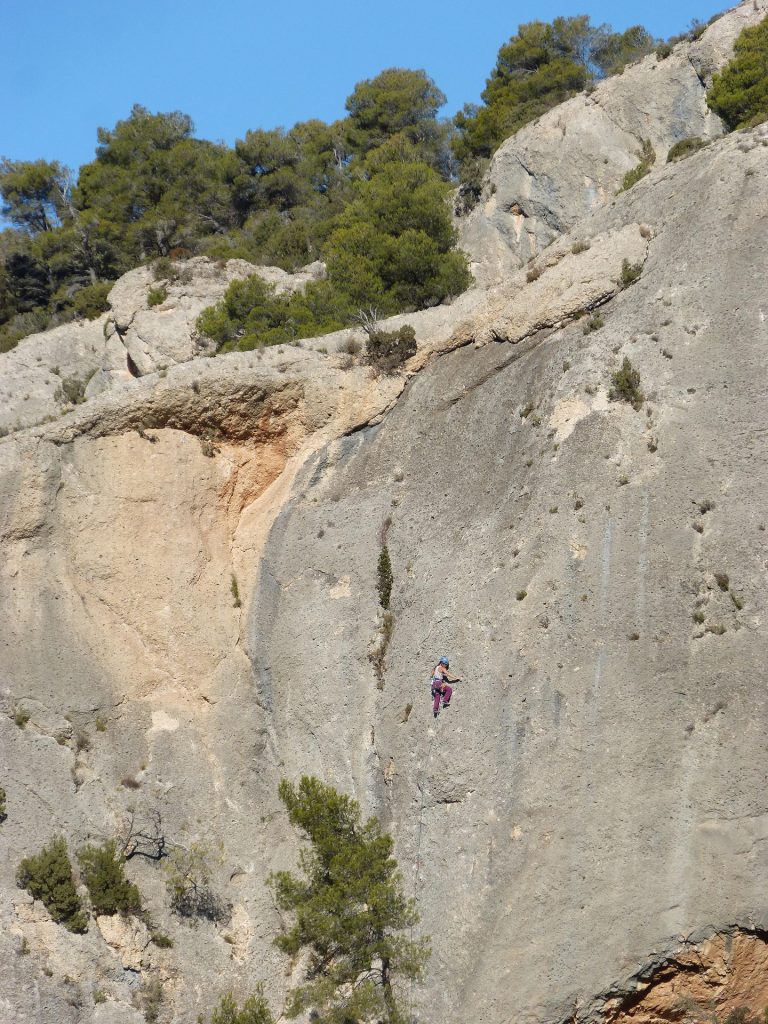
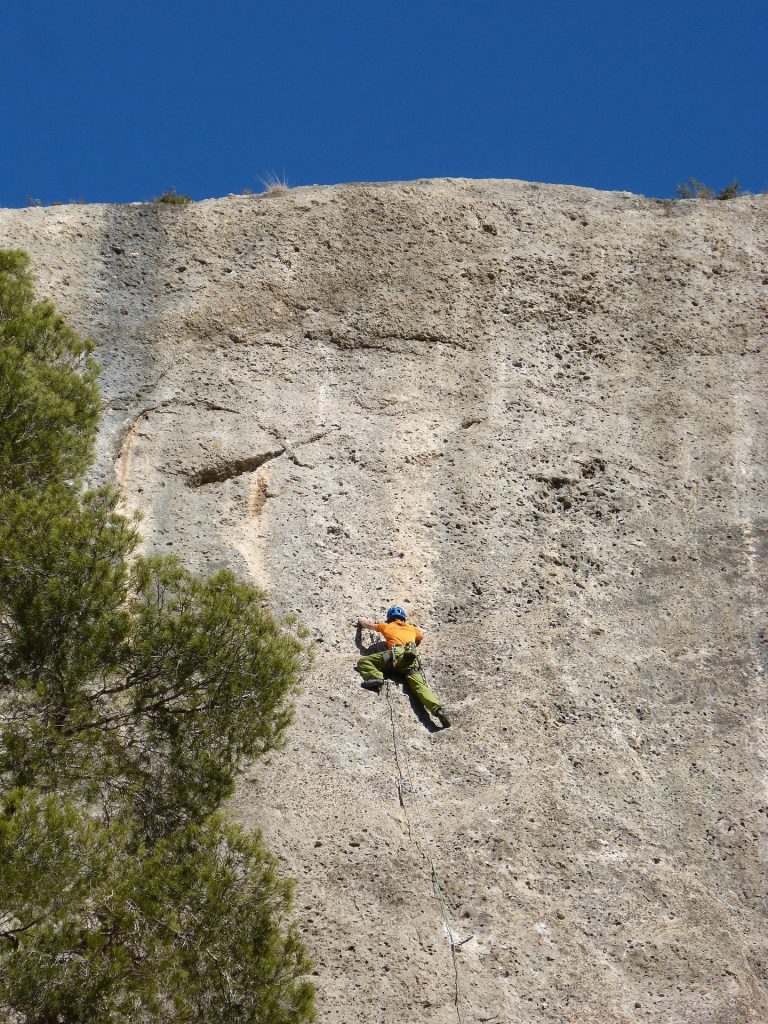
Conglomerate is a sedimentary rock made of rounded pebbles cemented together. In Margalef the pebbles are small, rarely bigger than a golf ball, and in many places they are covered by a skin of calcareous tufa that hardens the surface and forms tufa curtains on some lines. Geologically, the Montsant massif is a mass of conglomerate of about 140 square kilometres, laid down by alluvial fans at the edge of the Ebro basin from the Upper Eocene onwards. There is even a geological unit called the Margalef Formation, named after the village, made of sandstones and conglomerates from the middle and upper Oligocene. You will sometimes read that Margalef is limestone: it is not.
How it feels
- Pockets. The signature hold is a pocket for one, two or three fingers. You will also find some edges and crimps.
- Angles. Most of the climbing is vertical or slightly overhanging, with steep caves and roofs in some sectors.
- Effort. Sustained walls ask for stamina; the caves ask for power and bouldery moves. Strong fingers matter more than technique on smears.
- Kneepads. Usually not needed.
- Skin and fingers. Pockets load tendons in a way many climbers are not used to. Warm up properly, do not crank hard on monos on the first day, and take rest days.
Rain and wet rock
The roofs and caves stay dry in the rain (in Racó de la Finestra, for example). You can climb in light rain, although wet lips can make it hard to reach the anchors. When the rock is wet, be careful and wait for it to dry.
How many routes, and at what grades
The count depends on how the sectors are grouped: the 2024 guidebook lists 1,831 routes in 95 sectors, and other counts give between about 1,500 and 1,960. Take «more than 1,800 routes in about 95 sectors» as your reference.
The key point about grades: easy climbing is a minority. Most routes are between grade 6 and grade 8, and grade 7 (7a to 7c+) is the most common. Routes of grade 5 or easier are a small part of the total. There are some very good beginner sectors, but only a handful; they are listed below.
Sun and shade: choosing your sector
Because the walls face every direction, the key decision every morning is sun or shade.
| Conditions | Best sectors |
|---|---|
| Cold winter day, you want sun | Espadelles (south-facing, sun almost all day), Punta Espadelles (sun until midday), Camí de l’Ermita (south-facing, all year), Balcó de l’Ermita, Cabernet, Top Mantel, Cingles del Molí |
| Mild day | Almost anywhere; La Mainadera, Camí de l’Ermita and Can Regino (private land: check access) work all year |
| Hot day | Racó de la Finestra (north-facing centre, shade almost all day), 7 Pecats Capitals (shade and wind), MQZ (shade and wind), Llargues del Torroner (shade all day), Balcó del Torroner (shade and wind), Pet de Monja (shade), Balcó de la Penya Roja and Racó de la Taverna (summer favourites) |
| Light rain | The roofs of Racó de la Finestra and the steep caves; bouldering in the Cova d’en Ros cave |
| Windy day | Avoid Bona Vista |
| Children with you | Bloc del Porc and Ca l’Arna, Can Lolo, Can Mansettes; good, roomy bases at Racó de les Espadelles, La Mainadera, Cova del Cavall, Espadelles Extensión, Racó de l’Heura and Tenebres Extensió (check its current status with the town council) |
Two details catch visitors out. Ca la Marta, in the Taverna area, is in the shade all day in winter, so it is cold then. And Cova Soleiada, despite its name («sunny cave»), faces northeast.
The six climbing areas at a glance
The sectors fall into six areas. Route counts are approximate; the grade column gives the range and, in brackets, the most common grade.
| Area | Routes | Character | Best season | Grades |
|---|---|---|---|---|
| Sant Salvador, Ermita and Finestra | About 575 | From grade 6 classics to the hardest routes in Margalef | All year, depending on the sector | 4b to 9c (mostly 7s) |
| Catedral and Comaclosa | About 425 | The most remote area, with long, hard routes | Depends on the sector | 5a to 9b (mostly 7s) |
| Espadelles | About 335 | The most popular winter area, sunny almost all day | Winter | 5+ to 9b+ (mostly 6s and 7s) |
| Pantano (El Pantà) | About 325 | Laboratori and the beginner sectors | Winter | 4 to 9b+ (mostly 6s) |
| Taverna | About 145 | A mix of beginner sectors, 7s and 8s | Summer in some sectors | 4b to 9b (mostly 7s) |
| Cova d’en Ros | About 30 | Short, steep routes; bouldering in the cave on rainy days | No data | No data |
Since the 2025 barriers, you drive to each area through one of the two controlled car parks (see the booking section above); if in doubt about which one, ask the town council.
Espadelles: the winter star
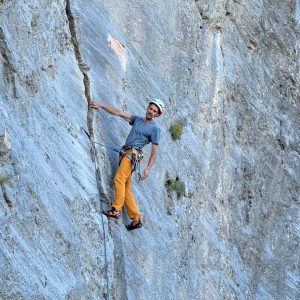
Espadelles faces south and gets sun almost all day, which makes it the best winter area. It has about 335 routes, with 6s, 7s and 8s in similar numbers, and several sectors with good bases for children. Park at the reservoir car park (Àrea Embassament).
| Sector | Routes | Grades and angle | Sun and notes | Classic routes |
|---|---|---|---|---|
| Punta Espadelles | ~36 | 6s and 7s, vertical to slightly overhanging | Sun until midday | Comendatore Paco 6b, Comebolas 6c, Els meteoròlegs 7a |
| Racó de les Espadelles | ~107 (with La Nevera and Transilvania, sometimes split into three sectors of 55, 21 and 28 routes) | Mostly 8s (7a to 9b+), very overhanging | One of the most popular sectors; good base for children | Memòria histèrica 6b, Setareh 6c, Què passa, neng? 7a, Draculín 7a+, Especial caballeros 8a |
| La Mainadera | ~48 | Vertical 6s, plus two caves with 8s | Climbable all year | Gest d’innocència 6b+, Baby sitter 7a, Rodillar 8a |
| Cova del Cavall | ~45 | A very steep cave of 7s and 8s, with walls of 5s and 6s; most routes are 6s | Good base for children | Carn de canó 7c, Adiós Paquito 8a |
| Espadelles Extensión | ~39 | Routes of about 20 m, vertical to slightly overhanging | One of the best areas for grade 7; the approach is a bit longer | Plis plas 6a+, Weissmuller 6c, Guybrush 7a |
| Bona Vista | ~17 | Short, vertical, mostly 6s and 7s | Avoid on windy days | |
| Bombo Taronja | ~22 | Long, overhanging 7s and 8s | Quiet |
At the top end, Adam Ondra climbed Directa Rodillar here in November 2020 and proposed 8c+/9a.
Contact the local professionals directly.


Pantano: Laboratori and the beginner sectors
The reservoir area ranges from beginner sectors to Laboratori, with several grade 9 routes. You park beside the track, and the sectors are very close to the cars. It uses the same Àrea Embassament car park as Espadelles.
| Sector | Routes | Grades and style | Notes |
|---|---|---|---|
| Laboratori | ~56 | 6a to 9b+, bouldery and very overhanging, stamina and power | You belay from the road, with traffic. Home of Demencia Senil 9a+, First Round First Minute 9b, El Potro 9a and Devoracordes 8a |
| Can Torxa (check the current status with the town council) | ~22 | Mostly 6s on excellent rock | South-facing, sun from 8:00 to 16:00, very close to the car. Routes include Follet Tortuga V+, L’Escorpí 6a, Freekandó 6b, Delicatessen 6c and Chachi qui chapi 7a |
| Can Llepafils (check the current status with the town council) | ~39 | Easy grades | The first sector bolted in Margalef (1997); suitable for adults starting out, not for children |
| Can Lolo | ~9 | All 4s and 5s | One of the few true beginner sectors |
| Can Gueli | ~14 | Athletic 6c and 7a on very good rock | On private land: check access |
| Can Pesafigues | ~21 | 5s to 6c+, slab and vertical, with stamina | |
| Cova Soleiada | ~23 | Very overhanging, mostly 8s | Faces northeast, despite the name |
| Cingles del Molí | ~29 | Mixed grades | A winter sector; you belay from the road |
| Can Si Fa o No Fot | ~25 | Athletic routes | On a ledge overlooking the reservoir |
| Balcó de la Penya Roja | ~12 | 7s and 8a | One of the best summer sectors; a 3-minute path with a steel cable on the last 50 m |
Sant Salvador, Ermita and Finestra
This is the biggest area and the one with the hardest routes. You reach it from the village along the track to the Sant Salvador hermitage, through the Sant Salvador barrier.
| Sector | Routes | Grades and style | Sun and notes | Classic routes |
|---|---|---|---|---|
| Camí de l’Ermita | ~29, plus 6 long ones | V+ to 7a, mostly 6s, 20 to 25 m | South-facing, climbable all year; the reference sector for grade 6 | Flor de Llit V+, Soc Roig 6a, La Chinita de Al Lao 6b, Flors i violes 6b+, Seca i meca 6c, Kagate Kid 6c+ |
| Balcó de l’Ermita | ~35 | Stamina 7s and 8s on the left, very hard routes on the right | Works in winter | Yihad 7b+, Brou de bou 7c, Laura 8a, Canto a la libertad 8a+ |
| Cabernet | ~32 | Short easy routes and bouldery 7s low down, stamina higher up | Needs an 80 m rope; sunny in winter | Lo fòrum de les postures 6c, Megapubis 7a, Califato coach 7b, Rajolida 7c |
| Bloc del Porc | ~28 | Very good easy routes and some 6s | Very short approach: great for beginners and children | |
| Ca l’Arna | ~20 | Short, bouldery routes on good rock | Good for families | |
| Pet de Monja | ~11 | Technical slab «like Montserrat», good 6s | Shade | |
| Racó de les Tenebres | ~26 | Short 6s and 7s on the left, stamina classics in the centre, a hard roof on the right | ||
| 7 Pecats Capitals | ~19 | Long, vertical 6s and 7s | Shade and wind: a good summer sector | |
| MVP | ~16 | Long, slightly overhanging, hard | MVP 7c, Ragnarock 8a | |
| Llargues del Torroner, Curtes del Torroner and Balcó del Torroner | ~22, ~23 and ~29 | The long routes («Llargues») are technical and vertical | Llargues: shade all day; Balcó: shade and wind |
Racó de la Finestra
Racó de la Finestra is a semicircular amphitheatre whose centre faces north. It is in the shade almost all day, and its roofs stay dry in the rain. It has about 113 routes, plus its extensions. This is a high-grade sector: there are few routes below 7a, and most are between 7b and 8b+. The classics at friendlier grades are Magrana 6c, Entretres 7a+, Sancho Pancho 7a+, Montgronyeta 7b+ and Antològica 7c. It is also home to the hardest route in Margalef (see the legendary routes below).
Catedral and Comaclosa: the long, hard area
The most remote area, with longer, harder routes and rock of great quality.
| Sector | Routes | Grades and style | Notes |
|---|---|---|---|
| La Catedral | ~52 | Very long 8s, stamina routes (30 m on the left, 40 m in the centre) | The only «easy» routes are on the right |
| La Visera | ~12 | Very hard | Home of Era Vella by Chris Sharma (2010), 9a, sometimes given 8c+ |
| L’Àtic | ~22 | Long 7s, perhaps the best rock in Margalef | Approach of about 25 minutes. La Marsellesa 7a+, Ben Calent 7c |
| Culample4 | ~28 | A 30 m wall of stamina climbing, vertical and overhanging | Many of the best 7s |
| Can Regino | ~33 | Long, vertical 6s | Climbable all year; on private land, so check the current access status first |
| Can Dit Gros | ~20 | Excellent 7s | Very good base |
| Racó de l’Heura | ~22 | Vertical and technical | Good base for children |
| MQZ | ~17 | Stamina routes | Shade and wind: recommended for summer |
| Purgatori | ~8 | Very hard: 8s on tufas, 9s in the centre |
Taverna and Cova d’en Ros
| Sector | Routes | Grades and style | Notes |
|---|---|---|---|
| Ca la Marta | ~54 | Short bouldery 6s and 7s on the right, very steep 8s in the centre, long vertical 6s and 7s on the left | In the shade all day in winter |
| Racó de la Taverna | ~16 | Long, athletic, 7a to 8a+ | Works very well in summer |
| Can Mansettes | ~20 | Easy, well-bolted routes | A good beginner area |
| El Tobogán and Totxo del Vi | ~20 | Slabs; easy, well-bolted routes at Totxo del Vi | On private land: check access |
| Cova d’en Ros | ~28 | Short, mostly overhanging | Close to the village; bouldering in the cave on rainy days |
The grades and route counts in these area tables are indicative: check them against the printed guidebook before choosing a route.
Every sector in Margalef, with grades
For planning, here is the full list by the three big access zones: Les Espadelles, Camí de Sant Salvador and Camí de la Presa. Together they hold more than 1,900 routes in 97 sectors, plus five outlying sectors (Can-Elone, Cova d’en Ros, Totxo de l’Àfrica, La Bisbal de Falset and Serra Major) with about 55 routes between them. Every count groups the sectors differently, so treat the totals as approximate. Note that this grouping does not match the printed guidebook: Camí de la Presa includes the Pantano, Taverna, Catedral and Comaclosa areas. Heights and grades are indicative.
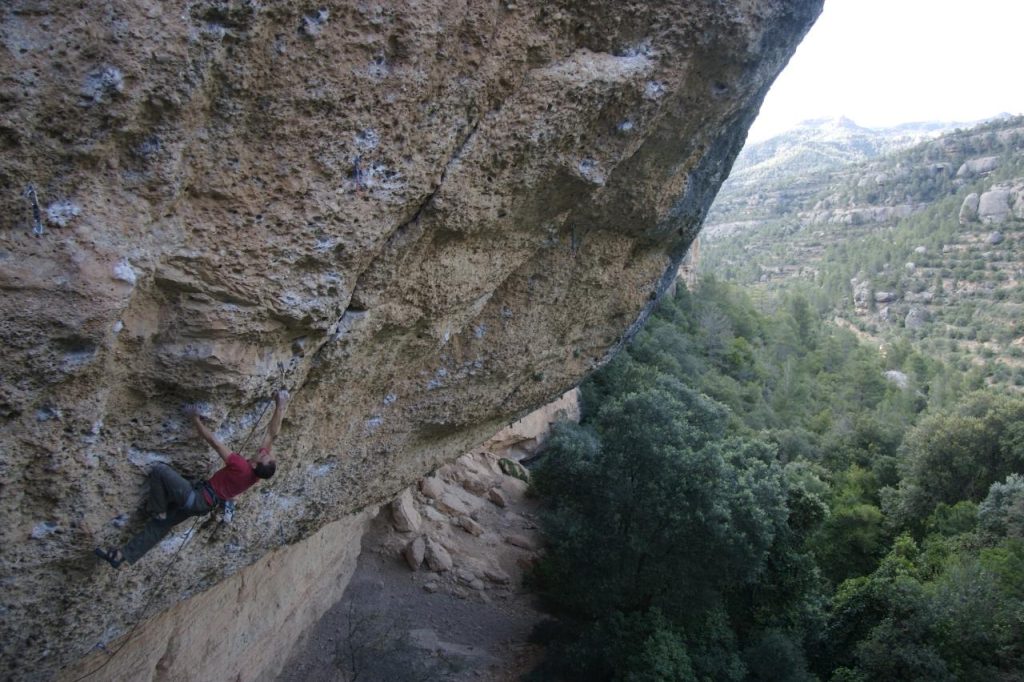
Les Espadelles (322 routes)
Routes from 5+ to 9b+, mostly 6s, 7s and 8s.
| Sector | Routes | Height (m) | Grades |
|---|---|---|---|
| Punta Espadelles | 33 | 19 | 6a+ to 7b (mostly 6s and 7s) |
| Totxo de les Espadelles | 8 | 16 | 5+ to 7b+ (mostly 6s) |
| La Nevera | 21 | 18 | 6a to 7a+ (mostly 6s) |
| Racó de les Espadelles | 55 | 23 | 7a to 9b+ (mostly 8s) |
| Transilvania | 28 | 21 | 6a+ to 8b (mostly 7s) |
| La Mainadera | 50 | 20 | 6a+ to 9a (mostly 8s) |
| Soledad | 14 | 16 | 6a to 8a (mostly 6s and 7s) |
| Cova del Cavall | 46 | 13 | 5+ to 8b+ (mostly 6s) |
| Espadelles Extensión | 34 | 17 | 6a+ to 8a+ (mostly 6s and 7s) |
| Bona Vista | 16 | 13 | 6a to 7c+ (mostly 6s and 7s) |
| Bombo Taronja | 17 | 20 | 6c+ to 8b+ (mostly 7s and 8s) |
Camí de Sant Salvador (671 routes)
This zone includes the Ermita, Tenebres and Racó de la Finestra. Routes from 4b to 9c, mostly 6s and 7s.
| Sector | Routes | Height (m) | Grades |
|---|---|---|---|
| Cova de la Cal | 14 | 12 | 7a+ to 8a (mostly 7s and 8s) |
| El Chumino | 8 | 9 | 5c to 6c+ (mostly 6s) |
| Baobab | 7 | 10 | 5c to 8a (mostly 6s) |
| Bloc del Roger | 9 | 7 | 7a to 8a+ (mostly 7s) |
| Margalwest (check the current status with the town council) | 18 | 14 | 5+ to 8a+ (mostly 7s) |
| Microbi | 14 | n/a | 5 to 7a (mostly 6s) |
| Cromosoma | 12 | n/a | 6c to 8a (mostly 7s) |
| Ecosistema | 14 | n/a | 6a to 7a+ (mostly 6s and 7s) |
| Cul de Sac | 19 | 12 | 6c+ to 8c (mostly 7s) |
| Ca l’Arna | 20 | 11 | 6a to 7c (mostly 6s and 7s) |
| Cal Jibé | 5 | 14 | 6b to 7c (mostly 6s and 7s) |
| Pet de Monja | 11 | 13 | 5c to 7a+ (mostly 6s) |
| Cal Zonazos | 15 | 18 | 6b+ to 8a (mostly 7s) |
| Tenebres Extensió (check the current status with the town council) | 17 | 25 | 6b+ to 7b+ (mostly 7s) |
| Racó de les Tenebres | 23 | 20 | 6a to 8c+ (mostly 7s and 8s) |
| Camí de les Tenebres | 17 | 18 | 6a+ to 7c (mostly 6s and 7s) |
| Bloc del Porc | 28 | 13 | 4b to 7c (mostly 6s and 7s) |
| El Pedruscall | 11 | 17 | 6a to 7c+ (mostly 6s and 7s) |
| Racó de la Finestra | 115 | 20 | 6b to 9c (mostly 7s and 8s) |
| Finestres Extensió | 46 | 23 | 6b+ to 8b+ (mostly 7s) |
| 7 Pecats Capitals | 19 | 27 | 6b to 7b+ (mostly 6s and 7s) |
| La Proa | 9 | 12 | 6a to 8b (mostly 6s to 8s) |
| L’Ou com balla / Tormo de l’Espantafrares | 5 | 17 | 6a to 7b (mostly 6s) |
| MVP | 15 | 22 | 6b+ to 8a (mostly 7s) |
| 4 x 4 | 15 | 13 | 6a to 8b (mostly 7s) |
| Camí de l’Ermita | 28 | 23 | 5a to 7b (mostly 6s) |
| Llargues de l’Ermita | 6 | 49 | 6c+ to 8a+ (mostly 7s and 8s) |
| Balcó de l’Ermita | 27 | 25 | 6b+ to 9a+ (mostly 7s and 8s) |
| Cabernet | 38 | 20 | 4c to 8c (mostly 7s) |
| El Meteorito | 12 | n/a | 6b to 8b+ (mostly 7s and 8s) |
| Llargues del Torroner | 22 | 25 | 6b+ to 7c (mostly 7s) |
| Curtes del Torroner | 23 | 15 | 6b to 8b (mostly 7s) |
| Balcó del Torroner | 29 | 19 | 6a+ to 8b (mostly 7s and 8s) |
Camí de la Presa (909 routes)
This zone includes the Pantano, Taverna, Catedral and Comaclosa areas, and most of the beginner sectors. Routes from 4 to 9b+, mostly 6s and 7s. Sectors on private land are marked: check the current access status before you go.
| Sector | Routes | Height (m) | Grades |
|---|---|---|---|
| La Granota | 8 | 9 | 5 to 6b (mostly 5s and 6s) |
| Cingles del Molí | 27 | 13 | 5 to 8a (mostly 6s) |
| Can Pesafigues | 20 | 15 | 5+ to 6c+ (mostly 6s) |
| Can Verdures (private land: check access) | 20 | 18 | 6b to 7c+ (mostly 6s and 7s) |
| Cova Soleiada | 22 | 17 | 6b to 8c+ (mostly 8s) |
| Can Torxa (check the current status with the town council) | 22 | 18 | 5+ to 7a+ (mostly 6s) |
| Flipadín | 9 | 10 | 6a to 6b+ (mostly 6s) |
| Can Tafarrae | 9 | 12 | 5 to 6b (mostly 5s and 6s) |
| Totxo d’en Fredi | 5 | 15 | 6b to 7b (mostly 6s and 7s) |
| Laboratori | 55 | 13 | 6a to 9b+ (mostly 8s) |
| Can Llepafils (check the current status with the town council) | 37 | 13 | 4 to 7a (mostly 5s and 6s) |
| Can Lolo | 9 | 15 | 4 to 5 (mostly 4s) |
| Can Gueli (private land: check access) | 14 | 16 | 6a to 7b+ (mostly 6s and 7s) |
| Totxo del Merendero | 3 | 16 | 6a+ to 7a+ (mostly 6s and 7s) |
| Can Nan3 | 5 | 15 | 4b to 5b (mostly 4s) |
| Totxo Poruc (private land: check access) | 8 | 12 | 6a to 7b (mostly 6s) |
| La Braseria | 21 | 19 | 5c to 7c (mostly 6s) |
| Totxo Petit | 8 | 11 | 5b to 7b+ (mostly 5s and 6s) |
| Can Si Fa o No Fot | 23 | 22 | 6b to 7c+ (mostly 6s and 7s) |
| Balcó de la Penya Roja | 9 | 52 | 7a to 8a (mostly 7s) |
| Totxo del Pantà | 3 | 8 | 5c to 6b (mostly 5s and 6s) |
| Racó de la Taverna | 18 | 29 | 7a to 8a+ (mostly 7s) |
| Ca la Marta | 53 | 17 | 5c to 8b+ (mostly 6s and 7s) |
| Can Mansettes | 20 | 13 | 4b to 6b (mostly 5s) |
| Totxo del Vi (private land: check access) | 9 | 13 | 5b to 6a+ (mostly 5s and 6s) |
| El Tobogán (private land: check access) | 11 | 25 | 5b to 7a (mostly 5s and 6s) |
| Cova de l’Obac | 9 | 18 | 7b+ to 9b (mostly 8s) |
| Can Net (private land: check access) | 12 | 17 | 6a+ to 7c (mostly 6s and 7s) |
| Cal Remko | 13 | 21 | 7a to 8a (mostly 7s) |
| Can Malastret | 6 | 16 | 7a to 7c (mostly 7s) |
| Racó de l’Heura | 21 | 15 | 6b+ to 8b (mostly 7s) |
| Culample4 | 28 | 27 | 6c to 8a (mostly 7s) |
| Sector Fosc | 6 | 15 | 5c to 7c+ (mostly 6s and 7s) |
| Chorreras | 17 | 10 | 5a to 7b (mostly 6s) |
| Sector Reggae | 16 | 17 | 6a to 7b+ (mostly 6s) |
| Súper Reggae | 14 | 21 | 6c to 8a (mostly 6s and 7s) |
| L’Àtic | 22 | 20 | 7a+ to 9a (mostly 7s and 8s) |
| El Purgatori | 8 | 37 | 8b to 9a+ (mostly 8s) |
| L’Escut | 8 | 34 | 7b to 8a (mostly 7s) |
| La Planxa | 3 | 31 | 8a+ to 9b (mostly 8s and 9s) |
| Top Mantel | 6 | 11 | 6c+ to 7c (mostly 7s) |
| MQZ | 17 | 16 | 7a to 8a+ (mostly 7s) |
| Racó de la Coma Closa | 28 | 24 | 7b+ to 9a (mostly 7s and 8s) |
| La Visera | 13 | 43 | 8b to 9a+ (mostly 8s) |
| La Catedral | 54 | 25 | 6c to 8b+ (mostly 7s and 8s) |
| Totxo de la Catedral | 21 | 19 | 6b to 7c (mostly 6s and 7s) |
| Balbicho | 9 | 22 | 7a to 7c+ (mostly 7s) |
| Neorural | 18 | 20 | 7c to 8c (mostly 7s and 8s) |
| Sobregan | 13 | 19 | 6a to 6c+ (mostly 6s) |
| Balcó de la Coma Closa | 18 | 15 | 6a+ to 8a (mostly 6s and 7s) |
| Can Regino (private land: check access) | 32 | 21 | 5c to 7c+ (mostly 6s and 7s) |
| Can Dit Gros | 20 | 24 | 6a to 8a (mostly 7s) |
| Can Dit Xic | 29 | 21 | 6a to 7c (mostly 6s and 7s) |
French grades, in plain English
Margalef, like the rest of Spain, uses French sport grades. On the easiest routes you will also see UIAA-style Roman numerals (IV, V, V+). Spanish climbers often talk about «grade 7» to mean anything from 7a to 7c+. This conversion is approximate: no two systems line up exactly, especially at the lower grades.
| French | YDS (US) | UIAA | UK tech (trad) | UK E grade (trad) |
|---|---|---|---|---|
| 4a | 5.4 | IV | ||
| 4b | 5.5 | IV+ to V- | 4a | |
| 4c | 5.6 | V | 4b | |
| 5a | 5.7 | V+ | 4c | |
| 5b | 5.8 | VI- | ||
| 5c | 5.9 | VI | 5a | |
| 6a | 5.10a | VI+ | E1 | |
| 6a+ | 5.10b | VII- | 5b | |
| 6b | 5.10c | VII | E2 | |
| 6b+ | 5.10d | VII+ | 5c | |
| 6c | 5.11a/b | VIII- | 6a | E3 |
| 6c+ | 5.11b/c | VIII- | 6a | E4 |
| 7a | 5.11d | VIII | ||
| 7a+ | 5.12a | VIII+ | E5 | |
| 7b | 5.12b | 6b | ||
| 7b+ | 5.12c | IX- | E6 | |
| 7c | 5.12d | IX | ||
| 7c+ | 5.13a | IX+ | 6c | |
| 8a | 5.13b | X- | E7 | |
| 8a+ | 5.13c | X- | 7a | |
| 8b | 5.13d | X | ||
| 8b+ | 5.14a | |||
| 8c | 5.14b | 7b | ||
| 8c+ | 5.14c | |||
| 9a | 5.14d | |||
| 9a+ | 5.15a | |||
| 9b | 5.15b | |||
| 9b+ | 5.15c | |||
| 9c | 5.15d |
The UK columns are for orientation only: British tech grades and E grades describe trad climbing, where protection and risk change the grade, so they do not translate well to bolted routes. The Roman numerals on the easiest routes (IV, V, V+) are UIAA-style grades, roughly 4 to 5 on the French scale.
Which sectors for your grade
Beginners and families
The choice is small for an area this size, but good:
- Pantano: Can Lolo and Can Nan3, both grade 4 and 5. Can Llepafils (adults only) has also been a classic first sector: check the current status with the town council before going.
- Taverna: Can Mansettes and Totxo del Vi (on private land, so check access).
- Sant Salvador: Bloc del Porc, with very good easy routes and a very short approach, and Ca l’Arna.
- Good, roomy bases for children: Racó de les Espadelles, La Mainadera, Cova del Cavall, Espadelles Extensión, Racó de l’Heura and Tenebres Extensió (check its current status with the town council; the routes themselves are harder).
If it is your first time on rock, or your first time on pockets, a day with a qualified guide is the fastest way to start safely.
6a to 6c
Camí de l’Ermita (the reference sector: 20 to 25 m, all year), Can Regino (check access), Punta Espadelles, Pet de Monja, Can Pesafigues, Cingles del Molí, La Braseria, Soledad, Bona Vista, 7 Pecats Capitals and the left side of Ca la Marta. Can Torxa, a winter favourite in this range, is on private land: check the current status with the town council.
Grade 7
Espadelles Extensión, Culample4, Can Dit Gros, L’Àtic, Cabernet, Can Gueli (check access) and Tenebres Extensió (check its current status with the town council) are sectors where grade 7 dominates.
Grade 8 and harder
Racó de la Finestra, Racó de les Espadelles, Laboratori, La Catedral, Purgatori, Bombo Taronja, Cova Soleiada, Balcó de l’Ermita and the centre of Ca la Marta. This is where the grade 9 routes are.
Best routes by grade
Each line gives the route, the sector and the grade, from easiest to hardest. Lengths are not listed because most routes are about 20 m; La Catedral and the long sectors are the exception.
First routes (V+ to 6a+):
- Flor de Llit Camí de l’Ermita, V+
- Soc Roig Camí de l’Ermita, 6a
- Plis plas Espadelles Extensión, 6a+
The 6s (6b to 6c+):
- Comendatore Paco Punta Espadelles, 6b
- Memòria histèrica Racó de les Espadelles, 6b
- La Chinita de Al Lao Camí de l’Ermita, 6b
- Gest d’innocència La Mainadera, 6b+
- Flors i violes Camí de l’Ermita, 6b+
- Comebolas Punta Espadelles, 6c
- Setareh Racó de les Espadelles, 6c
- Weissmuller Espadelles Extensión, 6c
- Seca i meca Camí de l’Ermita, 6c
- Lo fòrum de les postures Cabernet, 6c
- Magrana Racó de la Finestra, 6c
- Kagate Kid Camí de l’Ermita, 6c+
The 7s (7a to 7b+):
- Els meteoròlegs Punta Espadelles, 7a
- Què passa, neng? Racó de les Espadelles, 7a
- Baby sitter La Mainadera, 7a
- Guybrush Espadelles Extensión, 7a
- Megapubis Cabernet, 7a
- Draculín Racó de les Espadelles, 7a+
- Entretres Racó de la Finestra, 7a+
- Sancho Pancho Racó de la Finestra, 7a+
- La Marsellesa L’Àtic, 7a+
- Califato coach Cabernet, 7b
- Yihad Balcó de l’Ermita, 7b+
- Montgronyeta Racó de la Finestra, 7b+
Hard 7s and 8s (7c to 8a+):
- Carn de canó Cova del Cavall, 7c
- Brou de bou Balcó de l’Ermita, 7c
- Rajolida Cabernet, 7c
- MVP MVP, 7c
- Antològica Racó de la Finestra, 7c
- Ben Calent L’Àtic, 7c
- Especial caballeros Racó de les Espadelles, 8a
- Rodillar La Mainadera, 8a
- Adiós Paquito Cova del Cavall, 8a
- Laura Balcó de l’Ermita, 8a
- Ragnarock MVP, 8a
- Devoracordes Laboratori, 8a
- Canto a la libertad Balcó de l’Ermita, 8a+
The legendary routes: 9a and harder
Few climbing areas in the world have as many routes at 9a or harder as Margalef. These are the most famous:
| Route | Grade | Who and when | Sector |
|---|---|---|---|
| Café Colombia | Proposed 9c | Jorge Díaz-Rullo, 13 March 2026, after about 240 sessions; bolted by Anghelo Bernal | Racó de la Finestra |
| Perfecto Mundo | 9b+ | Bolted by Chris Sharma; first ascent by Alex Megos on 9 May 2018 | Racó de la Finestra |
| Mejorando la Samfaina | Provisional 9b+ | Jorge Díaz-Rullo, February 2023 | Racó de la Finestra |
| Tuareg Blanco | Proposed 9b/9b+ | Alex Megos, between late 2024 and January 2025; bolted by Adrien Boulon | Espadelles |
| First Round First Minute | 9b | Chris Sharma, 19 April 2011; second ascent by Adam Ondra, 3 February 2014 | Laboratori |
| The Full Journey | 9b | Alex Megos, October 2022 | Racó de la Finestra |
| Demencia Senil | 9a+ | Chris Sharma, 2009 | Laboratori |
| El Potro | 9a | Adam Ondra, 26 November 2020 | Laboratori |
| Era Vella | 9a (sometimes 8c+) | Chris Sharma, 2010 | La Visera (Comaclosa) |
| Directa Rodillar | Proposed 8c+/9a | Adam Ondra, November 2020 | Racó de les Espadelles |
Café Colombia deserves a word: Díaz-Rullo proposed 9c, which would make it one of the very few 9c routes in the world. As far as we know it has not been repeated yet, so for now the grade is a proposal. Perfecto Mundo made Alex Megos the third person to climb 9b+, after Adam Ondra and Chris Sharma. It was later repeated by Stefano Ghisolfi (December 2018) and Jakob Schubert (November 2019).
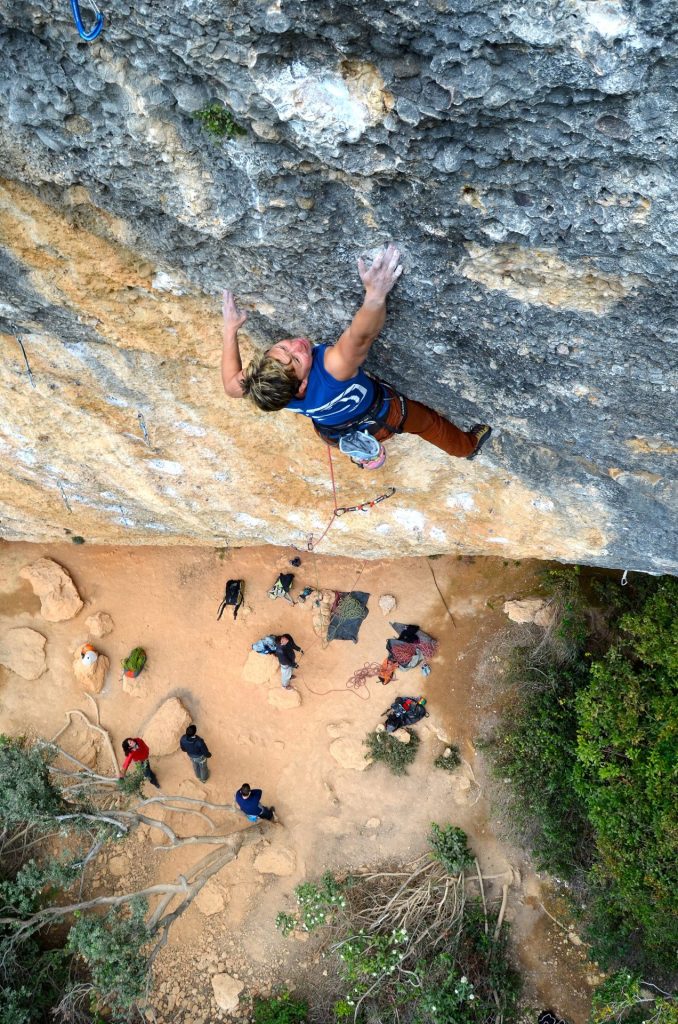
Laboratori and Racó de la Finestra hold most of these lines. If you go to watch, keep the bases clear and quiet.
A short history of climbing in Margalef
- 1996: the beginning. Climbing in Margalef began with Jordi Pou, who left the Barcelona coast to settle in the village. He bolted routes while restoring his house, Can Severet, and with his team he says he has bolted more than half of the routes in Margalef. The village refuge, the Refugi de Margalef, has been part of climbing life in the village since those early years.
- 1997. Can Llepafils became the first bolted sector.
- The first guidebook was a set of photocopied hand-drawn topos, bound and sold in the village shops and bars.
- 2006 to 2012: «the chaos». That is what the town council itself calls those years, when there were clashes between residents, tourists and businesses, and some landowners began to ban climbing on their land. Between 2011 and 2014 the village created camping areas and regulated camping.
- 2008. Dave MacLeod soloed Darwin Dixit in March 2008, a day after redpointing it on a rope. It was graded 8c at the time; today it is considered closer to 8b+. The film was only released in October 2019.
- 2009 to 2011. Chris Sharma climbed Demencia Senil (9a+, 2009), Era Vella (9a, 2010) and First Round First Minute (9b, 2011).
- 2018. Alex Megos made the first ascent of Perfecto Mundo (9b+).
- 2020. El Potro, bolted by Dani Andrada and never climbed until then, was freed by Adam Ondra. Ondra has tried to link it with First Round First Minute into a possible 9c he calls El Toro Salvaje, a project that is still unclimbed.
- June 2022. Chipped (manufactured) holds were found on routes in Racó de la Finestra. Nobody knows who did it.
- 14 October 2025. Car access to the two main areas came under barriers and online booking.
- 13 March 2026. Jorge Díaz-Rullo climbed Café Colombia and proposed 9c.
Visitors and the village. Estimates put the Margalef sector at about 89,000 visits a year, a little over half of all visits to the natural park. The estimated carrying capacity is about 51,000 visitors a year; the local climbers’ association disputes that figure and puts it at about two and a half times higher. The village had 641 inhabitants in 1887 and has just over a hundred today. The Sant Salvador hermitage, from the 16th century, is built inside a cave, and the Abric del Filador rock shelter is an important prehistoric site.

Getting to Margalef
Margalef is in the interior of the Priorat, about 65 km by road from Reus. You will need a car: the sectors are spread along tracks and roads around the village, and public transport is minimal.
Flying in
- Reus (REU) is the nearest airport, 71 km and about 1 h 20 by road. It is mainly a summer-season airport, with most flights to the UK and Ireland between spring and autumn. In winter there are few or no flights, so check before you plan around Reus.
- Barcelona El Prat (BCN) is the safe choice all year, 157 km and about 2 h 20 by road. It has the widest choice of flights and car hire.
- Girona (241 km, about 3 h 15), Valencia (279 km, about 3 h 45) and Zaragoza (205 km, about 2 h 45) also work if flights are cheaper.
Driving times
| From | Distance | Time (approx.) |
|---|---|---|
| Lleida | 54 km (34 miles) | 1 h |
| Reus city | 65 km (40 miles) | 1 h 15 |
| Reus airport | 71 km (44 miles) | 1 h 20 |
| Tarragona | 78 km (48 miles) | 1 h 25 |
| Camp de Tarragona high-speed rail station | 86 km (53 miles) | 1 h 30 |
| Barcelona El Prat airport | 157 km (98 miles) | 2 h 20 |
| Barcelona Sants station | 161 km (100 miles) | 2 h 20 |
| Zaragoza | 205 km (127 miles) | 2 h 45 |
| Valencia | 279 km (173 miles) | 3 h 45 |
| Siurana | 40 km (25 miles) | 55 min |
| Cornudella de Montsant | 33 km (21 miles) | 45 min |
Times are without traffic or stops. The roads into the village: from Falset by the T-710 through Gratallops and La Vilella Baixa, then the T-702 and T-713; from the north (Les Garrigues) by the C-242 and T-713; from Flix by the T-703, T-702 and T-713. From Barcelona airport you can drive via the coast and Reus, or inland on the A-2 via Igualada and Lleida, a toll-free route with fewer bends at the end. The AP-7 motorway has been toll-free in Catalonia since 1 September 2021, but the C-32 along the Garraf coast south of Barcelona still has tolls, so take the AP-7 instead.
The last kilometres are winding country roads, so allow time and drive slowly.
Hiring a car
- The main international rental companies have desks at Reus airport; in winter their hours can be short, so check the pick-up and drop-off times before you book. Barcelona airport has the biggest choice.
- Licences: EU and EEA licences are fully valid. With a licence from another country, the Spanish traffic authority (DGT) recommends carrying an International Driving Permit together with your national licence. Check with your rental company before you travel.
- Automatic cars are available but in shorter supply, so book early if you need one.
- Do not leave anything visible in a parked car, at the crag or in the village.
Public transport
Possible for getting close, not for climbing:
- Train: the nearest station is Marçà-Falset, served by the R15 regional line from Barcelona and Reus when trains are running; services have at times been replaced by buses. Check the current timetable with Renfe or Rodalies de Catalunya before planning.
- From Reus airport: the line 50 town bus runs to the centre of Reus, roughly hourly in the daytime, with extra services in summer and at Easter. Check the current timetable.
- Bus to Margalef: services to Falset and Móra d’Ebre are very limited, partly shared with school transport, and there is no current official timetable to rely on. Ask the town council (+34 977 819 167) before you plan.
- Even if you reach the village, the sectors are spread out and car access is by booking, so a car is the realistic option.
Where to stay, legally
The most important rule: camping, sleeping in a vehicle and lighting fires are banned inside the protected area, and the car park booking is for parking only. Wild camping is prohibited and fined throughout the natural park; vehicles may only stay overnight in authorised municipal areas.
In Margalef
- Refugi de Margalef (Alberg El Racó de la Finestra): the village climbers’ refuge, with accommodation for couples, families and groups and a kitchen for guests. Carretera 7, +34 677 611 098.
- Apartments and rural houses: the town council keeps a directory of accommodation. Among the options are Cal Boli (apartments, +34 686 708 759) and Ca Calbet (rural house, Carrer de Baix 12, +34 607 264 841), plus La Fonda Margalef. Several other houses and apartments in the village rent to climbers.
- Camping El Pont: the camping area in the village, by the bridge, with a bar. Check current conditions, price and booking before you go: the natural park leaflet lists +34 687 771 687 for the village camping areas, and the town council can also help (+34 977 819 167). The second camping area, La Presa by the reservoir, may be closed: check before you go.
- Motorhomes: the municipal motorhome area in the village is moving to free municipal management; confirm its current status with the town council before you rely on it.
Nearby villages
If Margalef is full, or you want more services, these villages work as a base:
| Village | Distance from Margalef | What it offers |
|---|---|---|
| Cornudella de Montsant | 33 km, about 45 min | The service centre of the inland Priorat: health centre, fuel station, tourist office, rural houses and apartments, and a motorhome area; also the base for Siurana |
| Falset | 35 km, about 45 min | The Priorat capital (about 2,900 people): hotels, apartments, health centre, Tuesday market and the Priorat tourist office |
| La Morera de Montsant | A hill village on the other side of the Montsant, with a hotel and a refuge | |
| Ulldemolins | A village with a campsite (Càmping Montsant Park) and rural houses |
Reus and the coast (Cambrils, Salou) have plenty of hotels, but they are more than an hour away.
Tourist tax. Catalonia charges a small tourist tax per person on overnight stays, collected by your accommodation.
When to book. Book early for Easter, the 1 November long weekend and other public holidays.
Food, supplies and shops
In the village. Margalef has a village shop, La Botiga de Margalef (Carrer del Pont 4), and several bars: Cafè Vernet (Plaça de Sant Miquel 17), the El Pont campsite bar, Cal Calbet and El Tros de Llúpol. Opening hours are not published, so ask locally, and expect reduced hours out of season. There is also a municipal swimming pool and a sports court.
The big shop. Do your main shopping in Reus or Falset before driving up. Falset has a weekly market on Tuesdays (Plaça de la Quartera), and a bonÀrea supermarket opened there in October 2026.
Climbing gear. There is no climbing shop in Margalef. Bring all the gear you need. The local guidebook is sold in the village.
Wine. Margalef is in Priorat wine country, home of the DOQ Priorat and DO Montsant wines. Many wineries can be visited, but most ask you to book in advance, and some close to visitors during the harvest (September and October).
Daily rhythm. Lunch is usually from 13:00 to 16:00 and dinner from 20:00 to 23:00. Small shops often close for a few hours in the afternoon and on Sundays, so buy ahead for the weekend.
Rest days and things to do
The Priorat is a beautiful place to rest your fingers.
- Hiking in the Montsant: two official natural park trails start in Margalef: Sant Salvador (7.8 km, about 4 h 15, circular, moderate) and Racó del Teix (10.2 km, about 4 h 30, circular, demanding). Check the park’s current trail information before you go.
- Cartoixa d’Escaladei (28 km, about 40 min): the ruins of the Carthusian monastery of Escaladei, at the foot of the Montsant. Open Tuesday to Saturday, 10:00 to 17:30 from October to April and 10:00 to 19:00 from May to September; Sundays and holidays 10:00 to 15:00 all year. Closed on Mondays that are not holidays, on 25 and 26 December and on 1 and 6 January. The ticket office closes 30 minutes earlier. Tickets cost about €7 (+34 977 827 006).
- Poblet Monastery (46 km, about 1 h 05): a UNESCO World Heritage monastery. Monday to Saturday 10:00 to 12:30 and 15:00 to 18:00 (18:30 from mid-June to mid-September); Sundays and holidays 10:30 to 12:30 and 15:00 to 18:00 (18:30 in summer). Closed on 1 and 6 January and 25 and 26 December. Tickets are sold until 30 minutes before closing, and pets are not allowed, except guide dogs (+34 977 870 089). Check current prices.
- Wine tasting: the Priorat wine route has nearly fifty wineries open to visitors. Book ahead. The Priorat tourist office in Falset (C/ Miquel Barceló s/n, +34 977 831 023) can help.
- Falset (35 km): the Priorat’s small capital, with its Tuesday market.
- Tarragona (78 km, about 1 h 25): the Roman city of Tarraco, a UNESCO World Heritage site, with an amphitheatre and several Roman sites on a joint ticket.
- Reus (65 km, about 1 h 15): modernist architecture and the Gaudí Centre.
- The beach: Cambrils (70 km) and Salou (72 km) are about 1 h 20 away.
- Siurana (40 km, about 55 min): the hilltop village and its crags make a great day out, even as a rest day.
Nearby crags for a longer trip
If you have more than a week, several other crags are within reach of Margalef by road. Distances are approximate:
- Vilanova de Prades (about 29 km): about 430 routes on conglomerate and tufa, mostly short, from 4+ to 8b, in a small mountain village.
- Siurana (about 40 km): close to 2,000 routes on limestone around the hilltop village. See our Siurana climbing guide.
- Arbolí (about 48 km): several hundred sport routes on good limestone, in a quiet rural setting.
- La Mussara (about 57 km): several hundred routes on limestone in the Prades mountains, with technical, old-school grades.
- The rest of the Montsant: the massif has more conglomerate crags around La Morera de Montsant, Escaladei and Cornudella; part of the cliffs above La Morera are only open from 15 July to 31 December.
The Prades mountains (Arbolí, La Mussara and Vilanova de Prades) may become a new natural park, but the decree had not been approved in October 2026. Check for any new climbing rules or closures before you go, and respect signs at the crag.
When it rains
- Climb under the roofs. The roofs of Racó de la Finestra and the steep caves stay dry in the rain. Wet lips may make it hard to reach the anchors, so pick your route carefully.
- Boulder in the Cova d’en Ros cave, near the village.
- Wait. After rain, take care on wet rock and give it time to dry.
- Indoor wall: SLAB in Reus (about 1 h 15 away) sells day passes for about €10.
- Culture day: Escaladei, Poblet, Tarragona or a winery visit.
Safety, rescue and gear
Emergencies
- Call 112 from any phone for any emergency. In Catalonia, mountain rescue is carried out by the Bombers de la Generalitat (the Catalan fire service) and its special operations group, GRAE.
- Medical care: Margalef has a municipal medical consulting room with limited weekly hours. Cornudella has a primary health centre (CAP), and Falset has a health centre. The large hospital is the Hospital Universitari Sant Joan de Reus (Av. del Dr. Josep Laporte 2, Reus, +34 977 310 300), about 1 h 15 by road.
- Mobile coverage is patchy in places. Tell someone where you are climbing, and save the booking code and your topos offline.
Climbing safety on conglomerate
- Loose pebbles: a pebble can pop out of the wall. Wear a helmet when belaying under busy walls, and do not stand directly under a climber.
- Roadside belays: at Laboratori and Cingles del Molí you belay from the road. Watch for cars and keep ropes and bags off the tarmac.
- Anchors and lowering: most routes are about 20 m; always tie a knot in the end of the rope, especially on the longer sectors (La Catedral, La Visera, Llargues de l’Ermita, Balcó de la Penya Roja).
- Fingers: pockets are hard on tendons. Build up gradually and take a rest day every two or three climbing days.
- The 23:59 rule: if you drive in, leave the car park before 23:59, or you will be locked in until the next day.
- Summer heat and fire risk: carry plenty of water, start early, and check the Pla Alfa alert.
Etiquette and local rules
Margalef is a tiny village that receives tens of thousands of visits a year. The town council asks visitors to:
- respect the natural park’s regulations;
- leave no rubbish: take everything home, including tape and food scraps;
- keep noise down at the crag and in the village;
- use the existing paths;
- respect temporary sector restrictions for wildlife.
And the park’s rules:
- Fire: no fires at the crags or in the car parks. Across the park’s forest land, no fire of any kind may be lit from 15 March to 15 October.
- Wild camping is prohibited and fined; overnight stays in vehicles only in authorised municipal areas.
- Drones need authorisation from the park.
- Dogs: follow the natural park’s general rules; if in doubt, ask the town council.
- New routes: in the free zone, new routes need prior notification to the park; in the conditional zone, prior authorisation. Never chip or glue holds.
- Private land: respect any sign, closed gate or landowner’s request.
- Climbing fees: there is no climbing fee; you only pay for the controlled car parks.
Practical information for international visitors
- Insurance. Your European Health Insurance Card (EHIC) or the UK Global Health Insurance Card (GHIC) covers necessary state healthcare on the same terms as a Spanish resident, but it does not cover everything: mountain rescue and repatriation are not included. Everyone, card or not, should have travel insurance that explicitly covers sport climbing and rescue.
- Licences and club cover. The Catalan mountaineering federation (FEEC) licence is for members resident in Catalonia or Spain, so it is not an option for most visitors. UK residents can buy BMC travel insurance (Rock policy) that covers rock climbing and search and rescue: check the current policy and eligibility. Members of the German Alpine Club (DAV) have mountain-rescue cover through the club, but confirm with the insurer that rock climbing on a trip like this is included.
- Emergency number: 112.
- Language. Catalan is the local language and Spanish is also official; most official information is in Catalan and often in Spanish and English. The car park booking site is in Catalan, Spanish, English and French. A few words of Spanish or Catalan go a long way in the village.
- Money. Spain uses the euro. Carry some cash for small bars and shops.
- Time zone. Central European Time (UTC+1 in winter, UTC+2 in summer).
- Driving is on the right.
Trip plans: 3 days, 1 week and 2 weeks
These plans follow the sun and shade logic: sunny walls in the cold months, shady and windy ones in the warm months. If you drive, book the right car park for each day. Can Torxa, Can Llepafils, Tenebres Extensió and Margalwest are left out until their access status is confirmed.
3 days at 6a to 6c
- Day 1: Camí de l’Ermita (20 to 25 m routes, all year; south-facing, so in summer go early).
- Day 2: Can Pesafigues and Cingles del Molí in the Pantano area (winter); in summer, 7 Pecats Capitals or Pet de Monja in the shade.
- Day 3: Punta Espadelles (sun until midday) or Espadelles Extensión.
3 days at 7a to 8a
- Day 1: Espadelles Extensión and Racó de les Espadelles (sun almost all day in winter).
- Day 2: Racó de la Finestra (shade almost all day, roofs dry in the rain).
- Day 3: Balcó de l’Ermita in winter; or L’Àtic and La Catedral for long routes (about 25 minutes’ approach to L’Àtic).
One week in Margalef (winter, from October to March)
- Day 1: Camí de l’Ermita or Bloc del Porc to learn how pockets feel, a grade or two below your maximum.
- Day 2: Espadelles: Punta Espadelles in the morning, then Espadelles Extensión or Racó de les Espadelles.
- Day 3: Balcó de l’Ermita and Cabernet (bring the 80 m rope).
- Day 4: Rest day: Cartoixa d’Escaladei and a winery visit, or the Sant Salvador trail.
- Day 5: La Mainadera or Cova del Cavall in the sun.
- Day 6: Racó de la Finestra on a mild day, or Laboratori to watch (and try) the steep stuff.
- Day 7: Back to your favourite sector for a final redpoint, with time to drive to the airport (Barcelona is about 2 h 20 away).
One week in Margalef (spring and summer)
- Day 1: Racó de la Finestra early in the morning.
- Day 2: 7 Pecats Capitals and Pet de Monja (shade and wind).
- Day 3: Llargues del Torroner and Balcó del Torroner.
- Day 4: Rest day: Poblet in the morning, or the beach at Cambrils.
- Day 5: Balcó de la Penya Roja and Racó de la Taverna, the summer favourites.
- Day 6: MQZ, or L’Àtic and La Catedral for long routes on cooler days.
- Day 7: Project day at Racó de la Finestra.
In July and August, climb at first light, carry plenty of water and check the fire-risk alert every day.
Two weeks: Margalef and Siurana
Siurana is 40 km (about 55 min) away by road and has a very different rock: limestone. Combining the two gives you limestone and conglomerate in one trip.
- Days 1 to 5: Margalef. Use the winter or spring week above, with a rest day on day 4 (Racó del Teix trail or Escaladei).
- Day 6: Long rest day: Poblet, Tarragona or Reus, then move base.
- Days 7 to 11: Siurana, from a base in Cornudella or Siurana, choosing sectors by sun and grade. Rest on day 9.
- Day 12: Rest day: wine and the Cartoixa d’Escaladei.
- Days 13 and 14: Repeat the best of either area, or finish your Margalef project.
One base, two crags. If you prefer not to move, Cornudella de Montsant is 33 km (about 45 min) from Margalef and much closer to Siurana. It saves packing, but adds driving on your Margalef days.
What to pack, by season
All year:
- Rope: a 60 m rope covers most routes, which are about 20 m, and a 70 m rope is a safe choice for most sectors. Cabernet needs an 80 m rope, and La Catedral has routes of 30 to 40 m, which also call for 80 m. The tallest walls (La Visera, Llargues de l’Ermita, Balcó de la Penya Roja) reach 43 to 52 m: check each route’s length in the guidebook before you lower off.
- Quickdraws: a dozen covers most routes; bring more for the long sectors.
- Helmet, especially when belaying under busy walls.
- Finger tape, chalk and a brush.
- The local guidebook or downloaded topos, plus your car park booking code saved offline.
- Headlamp: the days are short in winter, and some approaches take 25 minutes.
Winter (December to February): a light down jacket, hat and gloves for belaying in the shade and for the walk back, and a thermos. In the sunny sectors you can climb in a T-shirt at midday.
Spring and autumn: thin layers and a rain jacket; September, October and May bring the most rain.
Summer: light clothes, 2 to 3 litres of water per person, a sun hat and sun cream. Start very early and finish before the heat.
Guidebooks and topos
- The printed guidebook: Margalef climbing guide (2024 edition): 412 pages, 1,831 routes in 95 sectors, from 4 to 9b+, available in English and Spanish. It is sold in the village.
- Province guide: Tarragona Climbs (3rd edition, September 2023, 512 pages) is the province guide, with more than 4,800 routes in 11 areas.
- Online topos: use them with care, because many do not mention the 2025 access booking or the latest access status of each sector.
- Car park booking: parkingsmargalef.com.
Plan your trip with qualified guides
If you want help planning your week, choosing sectors for the conditions, learning to climb on pockets or taking your first steps on rock safely, you can contact qualified guides who work in Margalef and the rest of the Priorat, and browse their courses and activities, through Destino Climbing.
Frequently asked questions about climbing in Margalef
How many routes are there in Margalef?
More than 1,800. The 2024 guidebook lists 1,831 routes in 95 sectors, from 4 to 9b+; other counts give between about 1,500 and 1,960, depending on how sectors are grouped. A proposed 9c was added in March 2026.
Do I have to pay to park in Margalef?
Yes, if you drive to the two main areas. Since 14 October 2025 you must book online at parkingsmargalef.com and pay €5 per vehicle per day for the Sant Salvador or reservoir car park. If you leave one car park and want to go to the other the same day, you make a new booking there, free of charge, if spaces remain. Residents park free.
What time do the barriers open and close?
Sant Salvador opens at 4:00 and the reservoir area at 5:00. Both close at 23:59, and you must drive out before then: after that the barriers stop working until the next day.
Can I sleep in my van at the crag?
No. Camping, sleeping in vehicles and fires are banned inside the protected area, and the car park booking is for parking only. Stay in the village (refuge, apartments, rural houses, the El Pont campsite area) or in a nearby village, and use authorised municipal areas for motorhomes.
Is Margalef good for beginners?
It has some good beginner sectors, such as Can Lolo, Can Nan3, Can Mansettes and Bloc del Porc, but they are few compared with more than 1,800 routes. More than half of the routes are grade 7 and 8, and very few are below grade 6. It suits climbers who already climb comfortably in the 6s; for a first time on rock, go with a qualified guide.
When is the best time to climb in Margalef?
October to March on the sunny sectors, such as Espadelles and Camí de l’Ermita, and spring to summer on the shady, windy ones, such as Racó de la Finestra and 7 Pecats Capitals. February, March, April, October and November are the busiest months.
What kind of rock is it?
Conglomerate: small rounded pebbles cemented together, with one- to three-finger pockets and tufas. It is not limestone.
Can I climb in Margalef when it rains?
The roofs and caves, such as those in Racó de la Finestra, stay dry in the rain, and you can boulder in the Cova d’en Ros cave. In light rain the lips near the anchors can be wet.
Are there bird-nesting closures?
On the natural park’s map, the Margalef climbing areas are in the free zone, where climbing is allowed all year. Temporary restrictions for wildlife can still apply, so check the park’s current calendar (+34 977 827 310, pnmontsant@gencat.cat) and follow signs at the crag. Some sectors are on private land: check their status with the town council.
What rope do I need?
A 60 m rope is enough for most routes, which are about 20 m long. Cabernet needs an 80 m rope, and La Catedral has routes of up to 40 m.
How do I get to Margalef without a car?
It is very difficult. Bus services are very limited and the nearest station, Marçà-Falset, is still some distance away. Rent a car at Reus or Barcelona airport.
Where is the hardest route in Margalef?
In Racó de la Finestra: Café Colombia, climbed by Jorge Díaz-Rullo on 13 March 2026 and proposed at 9c.
Informational guide written for Destino Climbing. Data on routes, grades, access, fees, closures, prices and timetables are indicative and change over time; check the current regulations and the real condition of each sector before you go. Last reviewed: October 2026.