Costa Blanca Climbing: The Complete Guide to Alicante’s Crags, Walls and Routes
Climb and learn with a certified local guide Tell us your plan →
Every winter, climbers from half of Europe swap frozen crags for warm limestone, and a large share of them land in the same place: the province of Alicante, better known as the Costa Blanca. Within an hour or two of one international airport you get sport crags by the hundred, mountain routes of up to 1,000 metres, sea cliffs, sandstone boulders, deep water soloing above turquoise coves and via ferratas, all on rock that is mostly dry and sunny from October to April. This guide covers all of it, area by area, with the access rules and seasonal closures that guidebooks struggle to keep up with.
A note on names first. «Costa Blanca» is a tourism brand for the whole Alicante coastline, from Dénia in the north to Pilar de la Horadada in the south. Climbers use it for the entire province, including the mountains and valleys well inland, and so does this guide. We list the areas by region, then by discipline, and finish with rules, safety, history and ready-made itineraries.
Contents18 sections
- The Costa Blanca at a glance
- How the Costa Blanca is organised
- When to go
- Getting there and getting around
- Sport climbing
- Multi-pitch climbing and big walls
- Deep water soloing (psicobloc)
- Bouldering
- Via ferratas
- Rest days, rainy days and climbing gyms
- Rules, closures and ethics
- Safety, insurance and emergencies
- A short history of Costa Blanca climbing
- Guidebooks and apps
- Sample itineraries
- Climb the Costa Blanca with a certified local guide
- Frequently asked questions
- Useful links
The Costa Blanca at a glance
- Where: the province of Alicante, south-east Spain. Most of the climbing sits between Calpe, Benidorm and Sella, 40 to 70 minutes from Alicante-Elche airport.
- Rock: mostly limestone, from grey slabs and pocketed walls to steep orange tufas. Boulderers also get sandstone at Crevillent.
- Styles: sport climbing, long multi-pitch classics, mountain ridges, bouldering, deep water soloing (DWS) and via ferratas.
- Size: several thousand sport routes. The main English-language guidebook, the 2026 Rockfax Costa Blanca, covers around 50 crags and more than 4,800 routes.
- Grades: everything from 3 and 4 on friendly slabs to 8c+ and beyond on the steepest walls. The area is famously rich in 5s, 6s and low 7s.
- Season: October to April is prime time. Summer is for DWS, high shady walls and early starts.
- Getting here: Alicante-Elche airport (ALC). You need a car for most crags.
- Check before you go: nesting closures at the Peñón de Ifach (north face, April to June), Cabeçó d’Or (Racó del Caldero sectors, roughly December or January to June) and several other crags. The full table is in the rules section below.
How the Costa Blanca is organised
The province is large and the crags are scattered, so it helps to think in regions. Each has its own character, its own base town and its own best season.
| Region | Headline crags | What it is good for | Natural base |
|---|---|---|---|
| Calpe coast | Peñón de Ifach, Sierra de Toix, Mascarat gorge, Olta, Castellet de Calp | Sea-view multi-pitch, sunny slabs, short days | Calpe |
| Marina Baixa (Benidorm, Finestrat, Sella) | Sella, Puig Campana, Ponoig, Guadalest, Penya Roc, Serra Gelada | The biggest sport complex and the biggest mountain walls | Finestrat, Benidorm, Sella |
| Marina Alta and the valleys behind | Llíber, Alcalalí, Garx, Aixortà, Los Pinos, Bolulla; Jávea sea cliffs and DWS | Quiet valley crags, shade, sea-level DWS | Jalón (Xaló) valley, Jávea, Dénia |
| Alcoià and Comtat | Mas de la Penya, La Basseta, Castellar, La Uixola, Millena | Cooler inland climbing, a cradle of local sport climbing | Alcoy, Cocentaina |
| North of Alicante city | Cabeçó d’Or, Busot, Foradà | Tufa walls, a famous summer-shade crag | Busot, Alicante |
| Vinalopó valley | Marín, Rincón Bello, Salinas, Peña Rubia, La Escola | Family crags, quiet days, sandstone bouldering | Elda, Petrer, Villena |
| Vega Baja (south) | Pared Negra, Redován, Cueva Ahumada, Rincón de Bonanza | Cold-day slabs and cave climbing | Orihuela |
The main climbing areas of the Costa Blanca. Tap a pin to jump to its section.
When to go
Short answer: October to April, with a sweet spot from November to March when the sun is low and the south faces turn into suntraps. Alicante’s winter days are mild and sunny (January averages 17 °C by day and 181 hours of sun), which is why climbers from colder countries come here from October to April. The numbers below show why.
| Month | Average high (°C) | Average low (°C) | Rain (mm) | Sun (hours) | Sea (°C) |
|---|---|---|---|---|---|
| January | 17.0 | 6.3 | 23 | 181 | 14.6 |
| February | 17.6 | 7.1 | 22 | 180 | 14.2 |
| March | 19.6 | 8.9 | 23 | 227 | 14.4 |
| April | 21.3 | 10.9 | 29 | 247 | 16.3 |
| May | 24.1 | 14.1 | 28 | 277 | 19.1 |
| June | 27.8 | 18.1 | 12 | 302 | 22.6 |
| July | 30.3 | 20.7 | 4 | 330 | 25.1 |
| August | 30.8 | 21.2 | 7 | 304 | 26.2 |
| September | 28.5 | 18.5 | 56 | 250 | 25.2 |
| October | 24.9 | 14.5 | 47 | 217 | 22.6 |
| November | 20.5 | 10.3 | 36 | 173 | 19.5 |
| December | 17.7 | 7.4 | 25 | 164 | 16.5 |
Air temperatures are the 1981 to 2010 normals for the Alicante weather station (AEMET), at 81 metres above sea level. Sea temperatures are monthly averages for Alicante. Treat the whole table as a guide to the coast, not to the crags, which are often higher and colder.
What the table does not tell you
- Altitude changes everything. Inland crags such as those around Alcoy sit at 500 metres or more and are several degrees colder in winter, with frost on clear nights. Foradà and Peña Rubia are higher still. Pack a warm layer and choose south faces.
- Autumn is the wettest season. September and October bring the heaviest rain on the coast, usually in short, violent storms. Winter is drier and steadier.
- Daylight is short in December. Around the winter solstice Alicante gets about 9.5 hours of daylight, with sunrise around 08:15 and sunset around 17:45 (our own calculation for the city). That is plenty for sport climbing but tight for a 450-metre route with a long descent.
- Summer is hot. July and August highs reach 30 to 31 °C on the coast and above 40 °C inland on the worst days. The sensible options are north-facing crags, early starts, and the sea.
- Wind. The easterly levante pushes humid air off the sea and brings cloud, and when strong, persistent rain and rough water. The westerly poniente arrives warm, dry and often gusty. Check the AEMET forecast the evening before, especially for exposed ridges and sea cliffs.

Getting there and getting around
Flights and airports
Alicante-Elche airport (ALC) is the obvious gateway, with low-cost connections to most of Europe. Valencia airport is a workable alternative if you are heading for the northern crags: it is roughly an hour and a half by road from Calpe and roughly an hour and a quarter to an hour and a half from Alcoy. Murcia airport is about an hour to an hour and a quarter by road from Alicante and suits Orihuela and the southern crags.
Driving times from Alicante airport
These are road-planner estimates for the drive to the nearest town, so add the approach to the crag itself.
| Destination | Distance | Typical drive |
|---|---|---|
| Orihuela (south) | about 50 km | about 37 min |
| Petrer and Elda (Vinalopó) | about 40 km | about 27 min |
| Sella village | about 59 km | about 42 min (plus about 4 km of road to the refuge parking) |
| Benidorm | about 58 km | about 40 min |
| Alcoy | about 63 km | about 50 min |
| Calpe | about 77 km | about 53 min |
| Guadalest | about 75 km | about 57 min |
Do you need a car?
Yes, for almost everything. Calpe, Altea and Benidorm are linked by the TRAM d’Alacant (line 1 runs Alicante to Benidorm in about an hour and ten minutes, and line 9 continues from Benidorm through Altea and Calpe to Dénia, roughly hourly) and by coach, which is enough to get you to the foot of the Peñón de Ifach. Sella, Puig Campana, the Xaló valley, Alcoy and the Vinalopó crags have little or no public transport. A hire car is cheap outside the summer peak and is the only practical way to cover several areas in a week.
Practical points for hiring:
- Some firms ask for drivers aged 25 or over, and most want a credit card in the driver’s name.
- Licence rules depend on your country. Some non-EU drivers are advised to carry an International Driving Permit, and some rental companies require it, while UK licence holders generally do not need one. Check with your hire company and your government’s travel advice before you go.
- Some dirt tracks to the crags are rough, so read the contract for restrictions on unpaved roads.
- Park only where the guidebook or local signs allow. Do not block farm tracks, gates or olive groves: access at several crags has been lost because climbers did.
- Do not leave valuables in the car. Thefts from parked cars happen at several crags, including Redován and Callosa de Segura.
Where to stay
There is no single best base. Most climbers choose by the walls they want to climb that week.
| Base | Close to | Why choose it |
|---|---|---|
| Calpe | Ifach, Toix, Olta, Mascarat, Castellet de Calp; Sella and Puig Campana within about an hour | The classic base for coastal walls, with every kind of accommodation and a bus station |
| Finestrat, Benidorm, La Nucía | Puig Campana, Ponoig, Sella, Guadalest, Echo Valley | Central for the mountains and for Sella, with the TRAM and many apartments |
| Sella and Relleu | Sella, Penya Roc, Cova de l’Aigua | Right at the main sport complex, with a recreation area at Font Major that allows camping |
| Jalón (Xaló) valley | Llíber, Alcalalí, Murla, Los Pinos, Garx | Quiet crags, villages with good food, cooler evenings |
| Alcoy and Cocentaina | Mas de la Penya, La Basseta, Castellar, La Uixola | Cheaper and cooler, with a large indoor climbing gym in Alcoy |
| Elda and Petrer | Marín, Rincón Bello, Foradà | Family-friendly crags that are quiet at weekends |
| Orihuela | Pared Negra, Redován, Cueva Ahumada | Cold-day climbing in the south |
Outside July and August, apartments, hostels and campsites are plentiful and generally good value, and the whole coast is used to visiting climbers. A few rules are worth knowing: wild camping is not allowed (it is patrolled in places), parks and natural areas ban camping, and some towns restrict overnighting in campervans, so look for a proper campsite or a designated campervan area. Climbers’ accommodation exists near Sella, and a recreation area with camping and campervan space at Font Major was the base for the federation’s 2026 climbing meeting. The Guadalest area has a small climbers’ refuge next to Peña Maura.
Sport climbing
This is the bread and butter of the Costa Blanca: bolted limestone in a huge range of styles, almost all within an hour of the coast. We start with the biggest crag, then work region by region.
Sella: the heart of the Costa Blanca
Sella, in the Sierra de Aitana behind Villajoyosa and Benidorm, is the leading sport crag in the province, the undisputed queen of Alicante climbing, and a classic winter-sun destination. It has roughly 500 routes. Grades run from III to 8c+, with the bulk in the 5s, 6s and 7s. The limestone is mostly unpolished on the quieter walls but can feel soft or polished on the most popular ones.
The crag is split into four zones, each with a very different feel.
| Zone | Character | Best for |
|---|---|---|
| La Moleta | A long ridge shaped like a rhino, with south-facing walls and buttresses, including the popular Final, Cajón de los Cuartos and Ojo de Odra sectors. Routes from 8 to over 50 metres, mostly 5s to 7s. The busiest zone. | Beginners, improvers and mid-grade climbers |
| El Divino | Cueva del Divino has overhangs, CP10M has 30-metre vertical walls at 6 and 7, and El Elefante is a technical wall up to about 80 metres. One of the quietest areas. | Technical climbers at 6 and above |
| Rosalía and Tafarmaig | A long ridge with walls up to about 100 metres and 54 old-school routes in the Rosalía sector alone, some needing gear. It is north-facing and shady, a good choice for hot weather. | Confident climbers at 6b+ and above, hot days |
| El Goleró | A remote area about three kilometres from the refuge, with almost 100 routes, more than half of them at 8th grade. Includes VIPS (steep, bouldery lines) and the huge, shaded Wild Side wall, about 150 metres wide with crimps, slopers, pockets and tufas, with routes averaging about 20 metres and sometimes passing 40 metres. | Strong climbers and projecters |
Route counts for the main sectors give an idea of scale: Wild Side 87, Rosalía 54, Sector Competición 36, El Elefante 34, Final 27, Doggy Guantánamo 26, Cajón de los Cuartos 23, Ojo de Odra 23 and Techo del Rino 22.
How Sella was built
The story of Sella is the story of Costa Blanca sport climbing in miniature.
- 1960s and 1970s: the first climbs at El Divino were done with artificial techniques by local climbers including Manolo Pomares, Pedro Notario, Rafa Botella and Montesinos.
- 1980s: a group of climbers, mostly from Elche and working with climbers from Alcoy, known as Los Petardistes de les Aristes bolted the first sport routes at La Sartén and began work on La Moleta. Comtitapel, a 7a from the late 1980s, set a new standard for difficulty in the area.
- 1990s: Nacho Sánchez was the main developer of CP10M and Rosalía and did most of the 1990s bolting at El Elefante, which Rowland and Mark Edwards had pioneered, Mark Edwards bolted the first lines at VIPS from 1990, and Wild Side was started in 1992 by José Miguel García Fraile. The area drew climbers from well beyond Spain, and in 1996 VIPS saw Ejecución radical, an 8c+.
- 1993: a climbers’ refuge opened in an old irrigation pump house near the Font de l’Arc.
- 2013: the land above La Moleta changed hands, and its new owners, themselves climbers, lifted an earlier ban on access. About 60 new routes followed, and sectors such as Cajón de los Cuartos and Ojo de Odra were re-equipped.
Sella: access and etiquette
- Leave the AP-7 at junction 66 and follow the CV-770 to Sella, then continue about four kilometres on the narrow road to the parking by the Font de l’Arc refuge. The road has blind bends and plenty of cyclists and farm vehicles.
- Do not park at the Final sector (the track is for residents only) and do not block lay-bys or the dirt tracks used by houses and forest and fire services.
- Wild Side is reached across private land and there have been confrontations with the landowner, so keep quiet, bring no dogs and stay on the approach. Take all litter home.
- Do not block the dirt tracks, which serve nearby houses and are needed by forest and firefighting services.
- No wild camping, fires or barbecues. On certain dates, such as Easter, the authorities can restrict many of the car parks.
- Each October the regional federation (FEMECV) holds its annual climbing meeting at a different crag: the 2023 and 2026 editions were at Sella (2026: 16 to 18 October, organised by the CREM club), while 2025 was held at El Genovés and Montesa.
The Calpe coast: Toix, Olta, Mascarat and friends
Sierra de Toix is the classic half-day venue, a ridge between Calpe and Altea with more than 130 routes from 10 to 150 metres on grey limestone slabs and near-vertical walls, mostly in the lower grades. It faces south to south-west, so it is sunny nearly all day, with a minimal approach. The main sectors are Toix Oeste (16 routes), Toix Suroeste (36), Johanna (19), the two Toix TV sectors (about 19 and 20) and the long Lejano Oeste wall (46, mostly III to 5+, with a handful of 6s up to 6c). Bolts can be widely spaced and some ledges carry loose rock, so treat many easy routes as semi-trad and wear a helmet. Development began in the 1970s, with Espolón Limabán in 1977, English, Swiss and German climbers equipping routes in the 1980s, and the Edwards brothers climbing what was then a mythical 8th grade here in 1987 and 1988.
Olta, above Calpe with views of the Peñón, has 29 routes in the two main sectors, The Corner and The Main Wall, from V to 7c. It is described as facing south-east, so it picks up the morning sun in winter, but in winter the sun leaves the crag in the early afternoon. Jens Münchberg started bolting here in the early 1990s, and many routes have since been re-equipped, although some easy lines on the right still carry old gear.
Castellet de Calp has about 40 routes, mostly 6s and 7s, and stays in shade almost all day, and the sport sector at the bottom of the Mascarat gorge has soft-rock easy routes that were re-bolted and that get shade early and sun until late afternoon. Mascarat is also a protected microreserve with strict route restrictions, covered in the rules section.
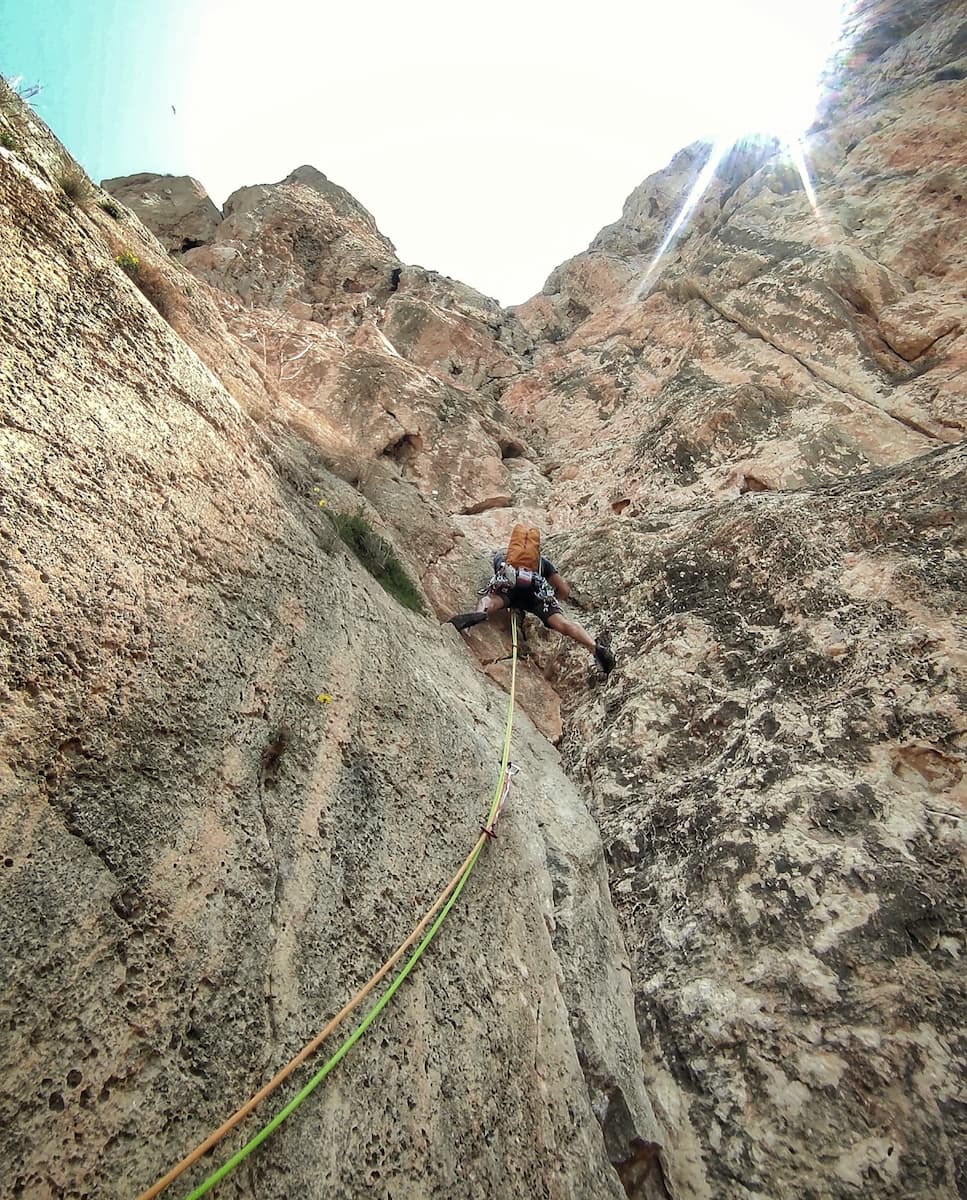
Benidorm, Finestrat and the Guadalest valley
Guadalest is one of the most beginner-friendly crags in the province. About 230 routes on two big rocks (Peña l’Hort and Peña Maura) are rarely harder than 6, face every direction, and are reached by a short approach. The longest are multi-pitch lines up to 80 metres. A small climbers’ refuge with 16 places sits a few metres from Peña Maura. Modern bolting began in 2000 with a local climber known as Tubo, and other local teams followed in the mid-2000s, including Miguel Á. «Potato» Bravo, who opened the refuge in 2011. Older classics first climbed by the Edwards brothers have since been re-bolted. The rock can be fragile when wet, so wear a helmet and avoid climbing after rain.
Abdet, roughly ten minutes by car beyond Guadalest, hides El Flare, a crag among trees behind old terraces with around 100 routes developed over several years, largely credited to the British climber Tom Phillips, and featured in the Rockfax guide. Parts of it were being re-bolted in 2025. Echo Valley (Vall de Guadar), on the flank of Ponoig near Polop, has about 100 routes in three sectors: the Carretera (IV+ to 7c, mostly 6), Echo 1.5 (slabs rarely harder than 5, built for courses) and the overhanging Arrán de Batistot.
Penya Roc (Racó de Tovaines) is the only sport wall in the province that always stays in the shade. Its roughly 50-metre overhang of white limestone, with crimps and tufas, has 53 routes, almost all 7a and harder (with a single 6c). Cova de l’Aigua is a true cave with 20 routes in all: ultra-overhanging lines never easier than 8th grade inside, plus 7s on the right and vertical 6s on the left, more than 15 km from the Sella core. Morro de Almaida has 23 sport routes on verticals up to 7b and overhangs up to 8, and El Cepellar near Altea offers 29 routes (17 in the 6s, ten 7s and two 8s) but has sensitive access: register at the urbanisation control post, use the tiny parking and avoid blocking the forest track.
The Jalón (Xaló) valley and the Marina Alta
Llíber (Penya Roja) is the valley’s showpiece: more than 80 routes from V to 8a+ in three sectors, a flat approach of a couple of minutes, and sun or shade most of the day. The Antiguo sector has about 45 routes averaging under 20 metres, mostly 6 and 7. Alejandría has caves with 7s and an easier wall. Climbing began here in 1986 with Roy de Valera’s trad route Lliberpool. One warning: the Xaló riverbed beside the sectors can flood in storms and cut the way back to the car, so avoid the crag after heavy rain.
Alcalalí has about 70 routes, mostly vertical or slabby, some reaching 40 metres or more, with a dozen 7s and lots of 4s to 6s. Some routes need an 80-metre rope. Climbing is totally forbidden inside the fenced private area on the right. One important caution: the whole Serra Seguili school, meaning Alcalalí, Murla and Murlalí, is reported closed all year by the councils of Parcent, Alcalalí and Murla since archaeological remains and rock art were found, with the University of Alicante studying the site. Posters at the sector entrances are reported to announce a temporary restriction, so treat the area as closed unless the councils or the local club confirm it has reopened.
Garx (known locally as Cerezos and in earlier guides as Las Cerezas) is a quiet crag with around 57 routes. The central slab holds 5s and low 6s up to about 40 metres, the right side is vertical to slightly overhanging (6b+ to 7b+) and the upper left has tufas for the hardest lines. Park only at the designated spot at the top of the paved track, walk down 10 to 12 minutes, and do not pick fruit. There have been frictions with landowners, and children should be kept away from the unwalled well in the Pozo sector.
Aixortà (Castell de Castells) is one of the area’s best summer crags: about 70 routes, mostly north-facing and shaded, on white limestone with crimps, pockets and tufas. It is hard and has a story. Climbing was banned in July 2020 to protect cliff vegetation, and a consensus agreement announced on 6 May 2022 reopened it once about 20 routes had been unequipped. New bolting is strictly forbidden, and the three small car parks hold only a handful of cars each.
Other crags worth knowing: Los Pinos (45 routes) is short and steep: its Pinturas sector (15 routes, overhangs up to 8b, best for climbers at 7b+ or better) is the hard end, while the Casa sector has smoother angles and about ten easier lines from V to 6c+, and the crag sits near a rock-art shelter; Bolulla (35 to 37 routes) is one of the quietest crags in the province; Murla (about 74 routes, mainly in the Coves de Murla and Crazy Crazy sectors) falls under the same reported closure; and La Solana (22 routes, shaded until early afternoon) suits mixed groups. Pego has a small school (roughly 10 to 30 routes).
Alcoy and the Comtat
Alcoy and nearby Cocentaina were among the cradles of sport climbing in the province, and the crags are quieter and cooler than the coast.
- Mas de la Penya (Cocentaina) has around 90 routes, averaging 25 metres on blue and orange limestone, with several 5s, many 6s and more than 50 routes at 7th grade. The walls and access path are private land belonging to a farmhouse owner, inside the Sierra de Mariola Natural Park, so park only in the designated places, keep the PR V-37 path clear, do not stay overnight or light fires, and leave unbolted lines alone from February to July (nesting).
- La Basseta (Alcoy) has about 97 routes at 5 and 6, under 20 metres, and is an easy-grade crag well suited to learning to lead.
- Barranquet del Ferri (Alcoy) is a small ravine with 57 routes up to 15 metres, ideal for beginners and climbable all year, and its hardest route is an 8a in a small cave.
- Castellar (Alcoy) has about 50 routes up to 8b+ and is shaded on its main north face, which makes it a summer option.
- La Uixola (Alcoy) has around 40 technical routes up to the 7s and 8s. Dimitrius Macropoulos (7c+) and Mejillas tiernas (8a) were among the first routes of those grades in the province.
- Millena (66 routes, mainly 7s with some 6s and a couple of 8s) is a quiet wall about two kilometres from its village.
North of Alicante: Cabeçó d’Or, Busot and Foradà
Cabeçó d’Or, the mountain above Busot and the Canelobre caves, is the province’s tufa capital. Its sport climbing is spread across several sectors:
- Jabugo (the main crag, about 80 to 98 routes in seven sectors) includes the Jamón York sector, arguably the best beginner crag around Alicante, with slabs at 4 and 5.
- Tocayo (49 routes, IV to 8a+, mostly 6) has vertical «raindrop» walls and steep overhangs, 20 to 25 metres high.
- Chorreras (72 routes) is a huge tufa wall with marathon routes of almost 60 metres, and its Sensación de Pinzar, opened in 2000, has a first pitch that may be one of the best 7c tufa pitches in the world. Use a rope of 80 to 100 metres.
- Sherpa (37 routes, mostly 7 and 8) is a 40-minute approach for top-level climbers only.
Chorreras, Sherpa and the other Racó del Caldero sectors (Sherpita, Peña de Alicante, Torre del Ojal, Cresta de las Jotas, Café Paraíso) are reported closed for nesting from January (sometimes from December) to June. The sectors are reviewed around March and some may reopen. Jabugo and Tocayo are not on the closure list, but always read the notice at the start of the path.
Foradà (Xorret de Catí), at around 1,000 metres, is one of the great summer classics of the whole Costa Blanca. The roughly 150 routes between V and 8th grade sit mostly on a north-facing wall, so shade is the main attraction, and the cold nights mean you should not come in midwinter without a warm layer. Some routes exceed 40 metres, so bring an 80-metre rope (use the longest you have, up to 100 metres). From the Xorret de Catí hotel parking, it is a 1.7-kilometre walk along a wide dirt track and then a path. The land belongs to the Alicante provincial council, and there are no known access problems. Foradà also holds a famous story. In 1990 the American climber John Bachar opened a route from the ground up with three bolts, came back a year later to find two bolts added, soloed it and named it «The Last Mohican» in protest.
The Vinalopó valley and the Vega Baja
- Peñas de Marín (Elda and Petrer) has around 60 routes in several sectors, climbable all year, mostly V and 6, and is popular with local families. Its classic zone has two-pitch routes of about 60 metres.
- Rincón Bello (Petrer, about 54 routes) is a shady, peaceful crag with a central orange wall of 30 to 40-metre routes at 7 and 8, and a few easier lines on the flanks. It sits by a Generalitat recreation area where camping needs a prior declaration.
- Salinas (60 routes) is a fingery, pocketed crag with a steep right sector that is hard for its grade. A bird restriction applies from about March to June (the dates change from year to year), so check the notice.
- Peña Rubia (Villena, around 90 routes, 4c to 8a) faces north-west, gets afternoon sun only and is far too hot in summer. The holds are polished and it has a hard reputation.
- La Escola (Crevillent, 42 routes) is the place for 5s and 6s on pocketed grey limestone, with a small overhang for the harder lines. Local climbers opened the first artificial routes here in the 1960s and 1970s.
- Agujas Rojas (Onil) has around 40 routes in the 6s and 7s with plenty of shade from pines, but federation regulations ban climbing there from March to June for nesting, so plan a spring visit accordingly.
- Cabreras and the Peñas del Rey (Sax) were a popular medium-grade crag with around 60 to 80 routes, but new landowners put up a no-climbing sign on 23 November 2024. Treat it as closed unless the local climbing club says otherwise.
In the south, the Orihuela area is a good cold-day option:
- Pared Negra has about 30 routes, mostly multi-pitch lines of 60 to 155 metres at V to 6a, on a south-facing wall that is too hot outside winter, with parking by the N-340 and a 20-minute walk.
- Redován has two big schools, El Rut (about 80 to 98 routes with a cave of 40-metre-plus lines at 7) and La Pancha (about 94 routes, mostly 5s and 6s, a good place to begin leading). The sector called Botri is banned all year to protect Bonelli’s eagle, and local signs are reported to ban Botri and Los Cortaos from January to June.
- Callosa de Segura (Cueva Ahumada) has about 60 sport routes, including an easy «La Escuela» sector of 30-plus short routes that suits beginners. The long routes on the Rabosero wall are closed from 1 January to 31 July, and from 1 August to 31 December about a dozen of them need prior authorisation. No new routes may be opened inside the Cueva Ahumada flora microreserve.
- Rincón de Bonanza is heavily regulated, with many routes banned all year and others banned from March to June (see the rules table).
- Bóveda de Orihuela (30 routes, best for 7th and 8th grade, climbable all year but best in spring) and Sudamérica (27 routes, mainly 7s, sunny and a good winter venue) are the harder crags here. El Balcón is a small south-facing wall of 15 routes at 6 and 7, suited to the coldest winter days, and Las Yeseras is a 6th-grade crag nicknamed the «Little Cervino».
Best crags by level and situation
| If you want… | Go to |
|---|---|
| Easy routes (grades 4 to 5c) | Echo 1.5 in Echo Valley; Guadalest; Jamón York at Jabugo; the «La Escuela» sector at Callosa; La Basseta and Barranquet del Ferri in Alcoy; the central slab at Garx; Pared Negra |
| Mid-grade variety (6a to 6c) | Sella (La Moleta); El Rut and La Pancha at Redován; Guadalest; Tocayo; Marín; Las Yeseras; Garx and the 6s on Foradà’s north face |
| Hard routes (7a and above) | Wild Side and VIPS at Sella; Mas de la Penya; Los Pinos; Penya Roc; Cova de l’Aigua; Rincón Bello; Bóveda de Orihuela; Foradà (north face); Cabeçó d’Or (when open) |
| Shade in summer | Foradà (north face); Aixortà; Castellar; Penya Roc; Rosalía and Wild Side at Sella; Rincón Bello; Castellet de Calp |
| A cold winter day | Olta; Toix; Sella (La Moleta); Pared Negra; El Balcón; Callosa de Segura |
| Family-friendly | Guadalest; La Basseta; Marín; Llíber (flat approach) |
| Steep and overhanging | Wild Side and VIPS; Los Pinos (Pinturas sector); Cabeçó d’Or; La Uixola; Cova de l’Aigua |
| Quiet days | Bolulla; Millena; El Divino at Sella |
A word on rain: no crag is guaranteed to stay dry, so plan around the forecast. Overhanging walls such as Wild Side and the caves tend to shed rain, but dry rock is never guaranteed, and the Llíber riverbed is a bad place to be after heavy storms.
Contact the local professionals directly.

Multi-pitch climbing and big walls
What sets the Costa Blanca apart from most winter sport destinations is the long routes. In one week you can climb a sea cliff, a limestone needle and a 400-metre mountain face, with an easy approach, in the sun.
Peñón de Ifach (Calpe)
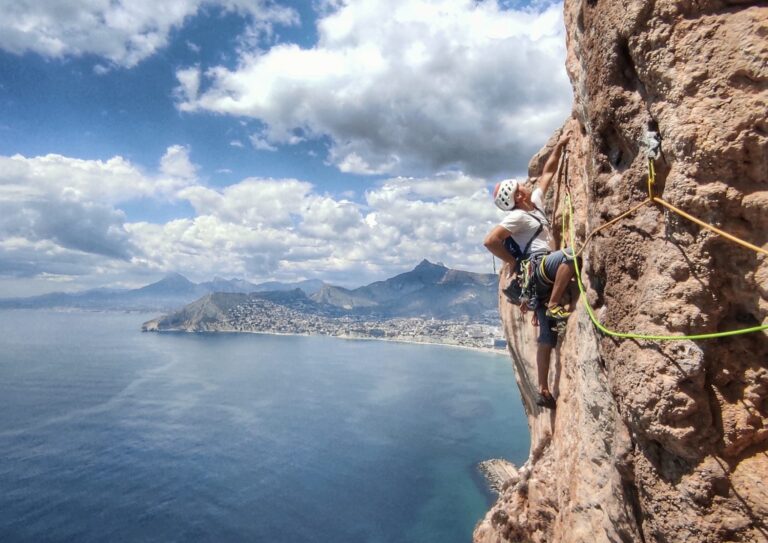
The Peñón de Ifach is a 332-metre limestone block that rises out of the sea at Calpe and is a landmark of the Costa Blanca. It is a Natural Park (declared in January 1987), and the Calpe tourist board lists 43 numbered climbing routes: 15 on the north side (including a few on the west face) and 28 on the south face. The longest, Sin Permiso de Obras, is 450 metres. Heavy traffic has polished the classic lines, and Calpe describes the rock on Gómez-Cano as worn and marble-like. Our complete Peñón de Ifach climbing guide has the full route list. These are the routes most climbers know:
| Route | Face | Length | Grade | First ascent |
|---|---|---|---|---|
| Pany | North | about 240 m | IV+ | 1955, J. Panyella and J. Salas |
| Valencianos | South | about 230 m | V+ | 1958, A. Martín, M. Gómez, A. Botella and A. Tebar |
| Piratas | South | about 150 m | 5 | 1979, J.M. González and A. Ballart |
| Diedro UBSA | South | about 250 m | 6a | 1977, L. Rodríguez, J. Guerrero and P. Oliva |
| Gómez-Cano | South | about 250 m | 6a+/A1 | 1977, M. Gómez and V. Cano |
| Anglada-Gallego | South | about 300 m | 6c | 1978, J.M. Anglada and M.A. Gallego |
| Costa Blanca | South | about 250 m | 6c+ | 1993, J. Arviza and S. Guerola |
| Directa Rusa | South | about 310 m | 6b/A3 | 1983, T. Gracia, E. López and A. Ballart |
| Sin Permiso de Obras | South | about 450 m | 7a/A0 | Equipped January 2004, R. de Valera and M. Cebrián |
Lengths follow the Calpe tourist board and can vary by 20 to 50 metres, so treat them as rough. The famous Diedro UBSA avoids its final overhangs with a pendulum abseil, and the classic lines are polished from heavy use (Valencianos, Diedro UBSA, Costa Blanca and Gómez-Cano).

Peñón de Ifach: the rules
- North and north-west faces: climbing is prohibited in April, May and June (generally given as 1 April to 30 June) for peregrine falcon nesting.
- South face: not banned. The park regulation asks climbers to tell park management beforehand; this is reportedly not enforced at present, so check with the park office. Gulls nest on the face in spring and can swoop at climbers, so many people avoid it then.
- The descent: almost every route finishes on the summit and descends by the Ruta Roja walking path, which needs a free reservation made online up to 10 days ahead (same-day booking is possible if slots remain). Reservations are personal and non-transferable. The path has a daily limit of 300 visitors.
- New routes are forbidden. Camping, fires, drones and loose dogs are banned in the park, and the park advises against being on the mountain after dark. Check with the park office before re-equipping any route. Children are discouraged from going past the tunnel, and the park rules say people under 18 may not.
If you plan to climb, check the park website and the reservation system before you travel. A certified local guide who does Ifach every week knows which routes are in good condition and handles the reservations.

Puig Campana (Finestrat)
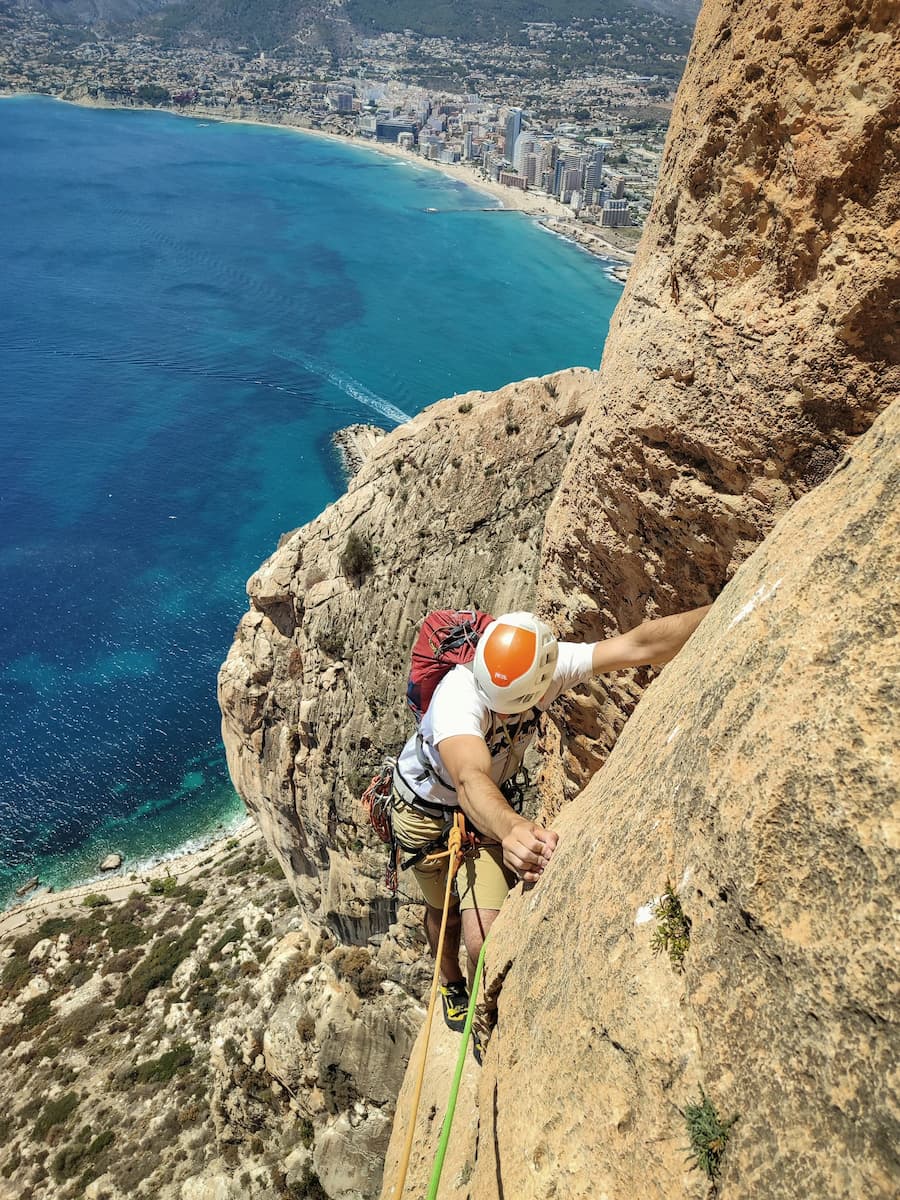
At 1,406 metres, the Puig Campana is the second highest mountain in the province, a bell-shaped summit about ten kilometres from the beach. More than 80 routes climb its faces, typically 350 to 450 metres on the south face and up to about 1,000 metres on the west face. Most are classic, protected with gear, pitons and rock bridges, with bolted belays. It sits inside a protected landscape (the Puigcampana and Ponotx) whose decree recognises climbing as a traditional activity, and as far as we know there is no specific climbing restriction there.
The classic is the Espolón Central on the south face: about 430 to 450 metres, grade V with IV obligatory, in nine pitches. Its first ascent is disputed. Many guides print 1965 and some 1962, 1963 or 1966, but Miguel Gascón, one of the party, says that he, Joan Roig and Carlos Torregrosa made the first ascent on 18 March 1970. The approach takes about an hour, the climb a few hours, and the descent 75 to 90 minutes down the «kilómetro vertical» gully between the Puig Campana and Pic Prim. Short winter days catch out slow teams, so carry a headtorch and be honest about timing.
| Route (south face) | Length | Grade | First ascent |
|---|---|---|---|
| Espolón Central | 430 to 450 m | V (IV obligatory) | 1970 per Gascón (many guides say 1965) |
| Diedro Gallego | 160 m | 6a+ | 1977, the García Gallego brothers |
| Diada del País Valencià | 350 m | 6a+/6b | 1977, P. Chorro and M. Pomares |
| Julia | 400 m | 6a/6b+ | 1981, Chema Ramírez and Manolo Pomares |
| Diedros Mágicos | 250 m | 6a+ | 1981, the García Gallego brothers |
| Viaje en el Tiempo | 400 m | 6c+ | 1982, Ramírez and Pomares |
| Nueva Edición | 175 m | 6c+ | 1995, Rowland and C.J. Edwards |
Grades and first-ascent dates in the table are approximate and vary from one description to another. On the west face the routes are much longer and more serious: the Noi (opened in 2006 and 2007) is reported at more than 1,000 metres in 25 to 28 pitches, and the Entorns is considered the classic of the west face. These are full mountain days, not sport routes, so allow most of a day or more and check current topos. See our complete Puig Campana climbing guide for the sectors, approaches and descents.
Ponoig (Polop)
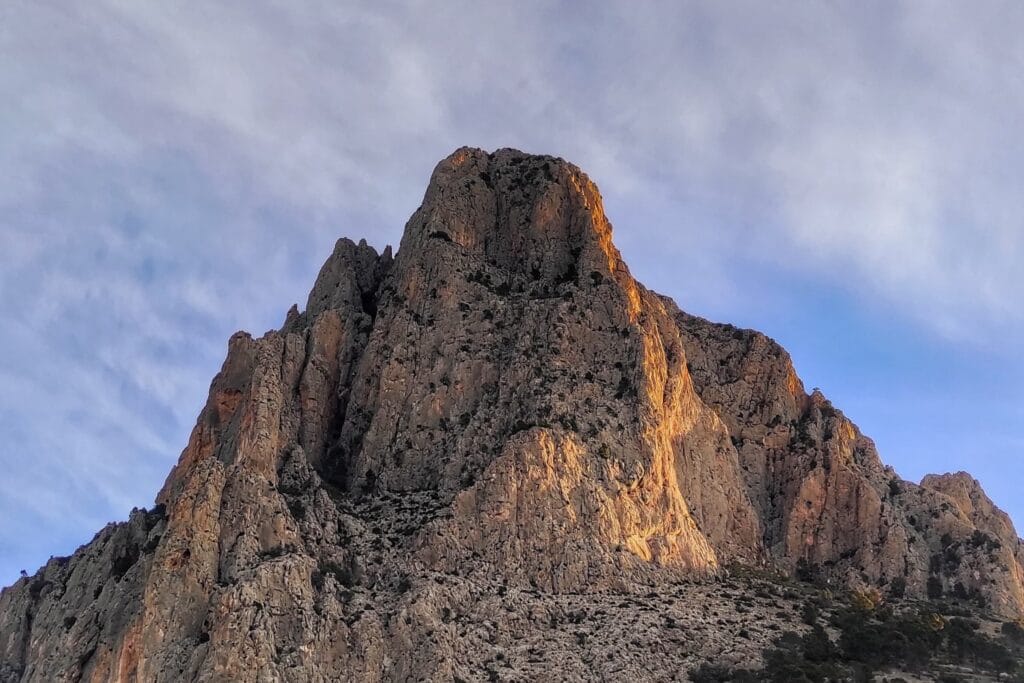
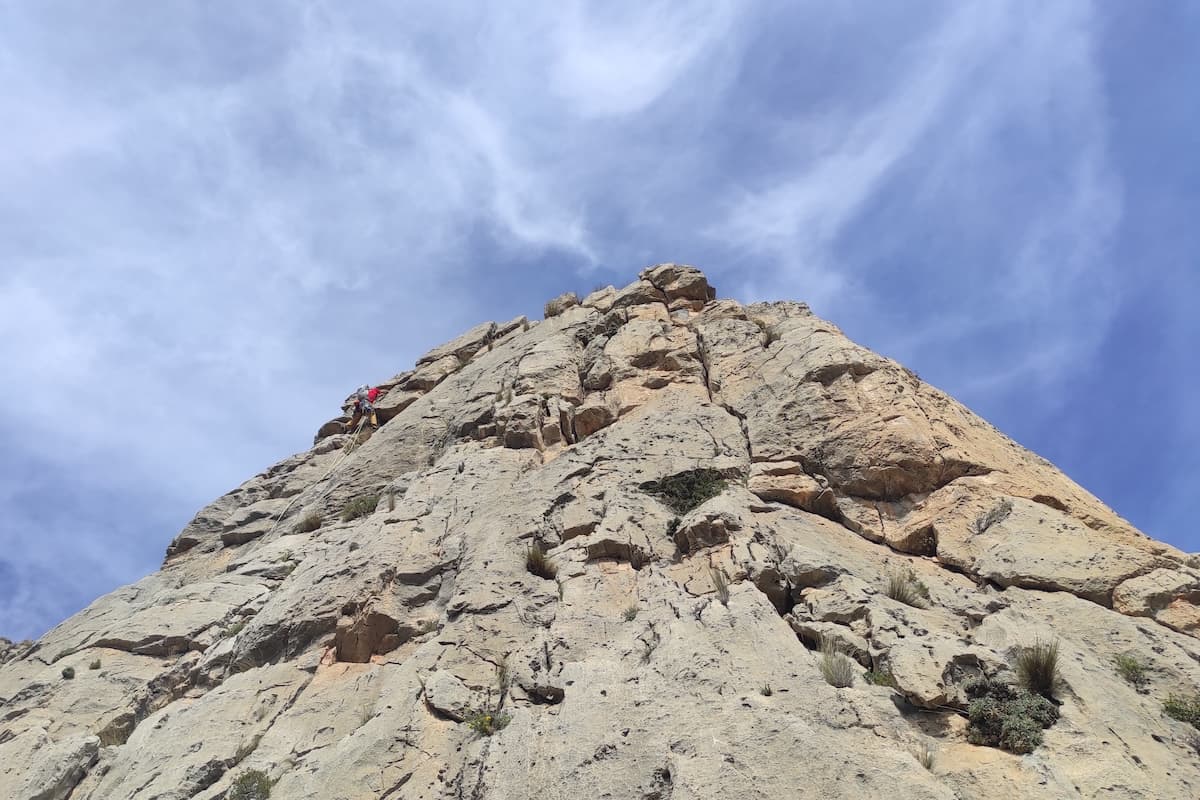
The Ponoig (or Ponotx) is the «sleeping lion» of the Costa Blanca, a 1,181-metre mountain north-west of the Puig Campana with walls up to about 500 metres. Its routes are long, serious and mostly traditional, with sparse bolts.
- Espolón de los Ingleses: the first route, climbed in 1970 by the British climbers Brian Royle and Kim Meldrum. It is now largely covered by a via ferrata.
- Valencianos: about 400 to 500 metres in around 13 pitches, with a crux at 6a: the most repeated route on the massif, first climbed in 1972. In 1985 Marisa Puchades and Amparo Abad made the first all-female rope-team climb on the wall.
- Fisura Hermanos Gallego: 350 metres, 6c+ (6a+/A0 obligatory) in ten pitches, first climbed in 1977 and restored in 2017. Do not assume you can rappel the route: the equipped stations belong to the neighbouring Café Licor, so check current beta before you go.
From the parking by the water tank near the Polop-Paradís urbanisation, the south and east faces are about 20 minutes away. The descent from Valencianos combines a walk-off with a long rappel and two more of roughly 25 to 35 metres, so bring two ropes and check current beta. Do not make the Ponoig your first multi-pitch: its descents are hard to find in poor visibility, and the routes are sparsely protected.
Cabeçó d’Or and other multi-pitch routes
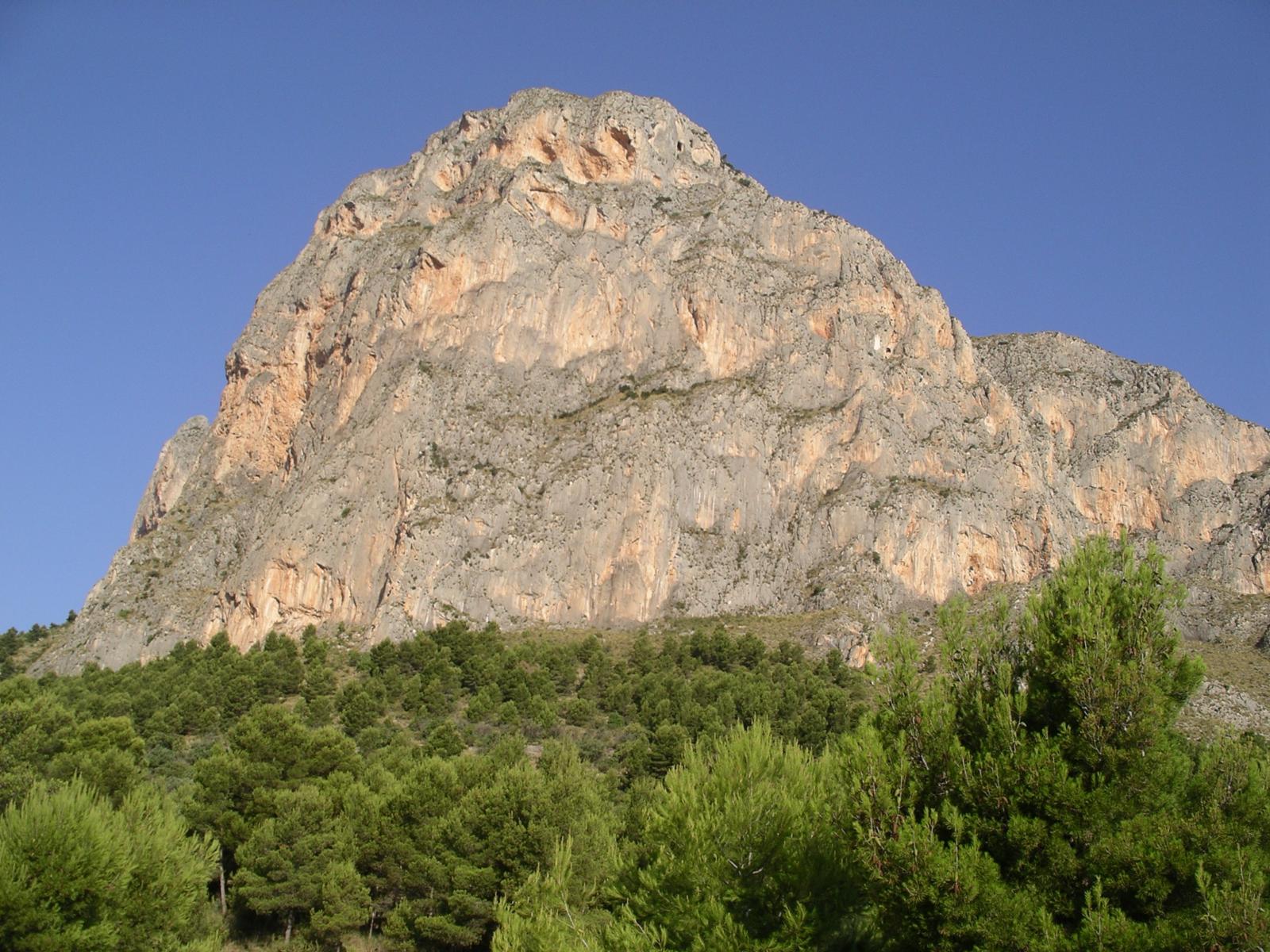
- Vía Gene (Pared de los Alcoyanos, Cabeçó d’Or): about 265 to 300 metres in five or six pitches, graded V on the original line (the popular Variante Despiste has a V+ pitch), first climbed free in November 1974 by Pedro Jorge Notario and Gustavo Llobet. It is a semi-equipped classic with old pitons and spits, an approach of roughly half an hour from the Pla de la Gralla parking and a two-rappel descent. Take double 60-metre ropes. Some Cabeçó d’Or sectors are closed for raptor nesting from roughly January to June, and the Pared de los Alcoyanos is not on the published closure lists, but check locally.
- Serra Gelada (Benidorm and Altea): the sandstone sea cliffs hold trad lines put up by the Edwards family, including the Diedro Edwards-Martínez. Ask a local guide for lengths, grades and first-ascent details. Climbing here is regulated: the Ciutadella sector is closed for nesting in winter and spring and needs prior authorisation the rest of the year, other sectors need email notice to the park, and sport routes cannot be added (see the rules section).
- Racó del Corb (Toix): the regulation for the Morro de Toix microreserve (Order of 13 June 2001, plus the 2009 ZEPA agreement) bans new routes and bans climbing except in three sectors (Candelabros del Sol, Piratas del Caribe and the west face of the Racó del Corb, away from the south face). It lists all south-facing routes for de-equipping, together with Luces Nocturnas, Missing Link, the upper part of Bailando al agua and the start of the Travesía Europa, which may not be climbed at all. Local tourist information may still list some of these routes, so check the federation regulations before you go.
- Mascarat gorge: long routes of roughly 135 to 260 metres on the needles by the bridge, partly inside a microreserve that allows only a short list of routes (see the rules section).
- Pared Negra (Orihuela): the Espolón de Pared Negra, about 110 to 155 metres in four pitches at grade 5, is one of the gentlest multi-pitch options in the south (mostly bolted, with some old fixed gear, so check it).
Ridges and scrambles
If you like mountain days with a rope in the rucksack, the Costa Blanca has a collection of classic ridges. The Cicerone guide Costa Blanca Mountain Adventures covers them.
- Toix Ridge Integral: about 510 metres of climbing at grade IV, 5 to 6 hours, linking the Toix Este, Toix Oeste and a short scramble. Bring a 60-metre rope and a light rack.
- Cresta de Bernia: a classic traverse of the 1,128-metre Sierra de Bernia, V at its crux, 6 to 8 hours, with several short rappels, starting at the Forat tunnel.
- Benicadell ridge: a classic scramble on a mountain of about 1,104 metres, with moves up to about IV and a short rappel. Grades and timings vary, and the approach starts across the border in Valencia province, so check current beta.
- Cresta de la Foradada (Cabeçó d’Or): an airy ridge scramble above the Canelobre caves, at around grade III to IV with one exposed step and a rappel to exit. Check the grade and timing in a local guide, and wear a helmet.
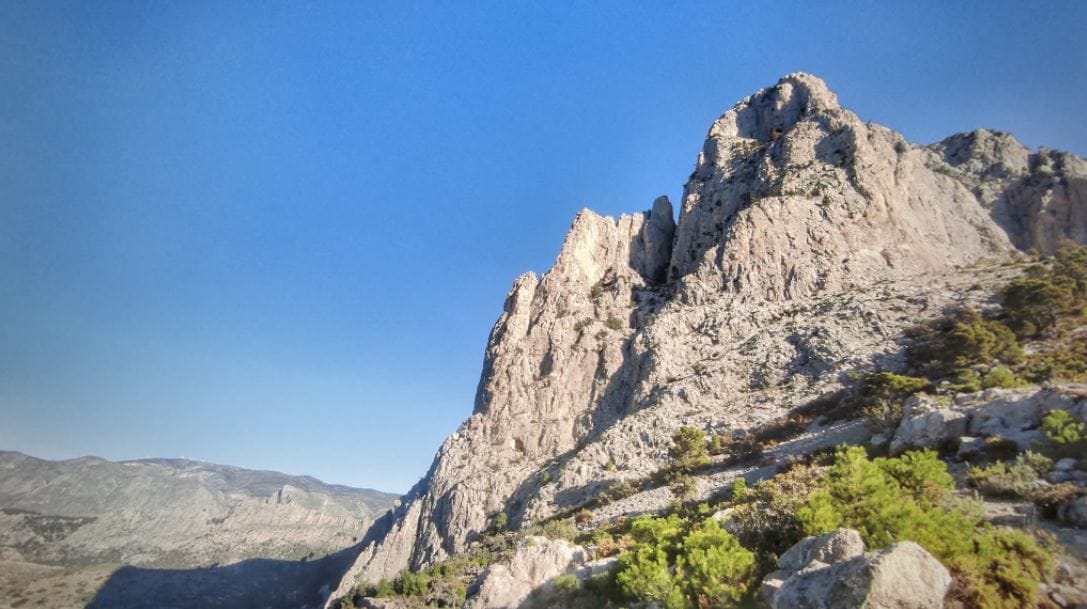
A first multi-pitch on the Costa Blanca
- Pany (Ifach, IV+): the easiest classic, grassy at the start, but closed April to June.
- Vía Gene (Cabeçó d’Or, V): a proper mountain route with old gear, best with a guide.
- Cresta de Bernia: a bolted crux and a big mountain day, best with a guide.
- Espolón Central (Puig Campana, V): a grade-V route, but a long mountain day with a 75 to 90 minute descent.
- Espolón de Pared Negra: about 110 to 155 metres, mostly bolted and gentle.
For any of these, bring two 60-metre ropes for the rappels, a helmet, a set of nuts and cams to size 3, slings, extendable quickdraws and plenty of water. The rock polishes quickly on the popular lines, so grades can feel harder than the numbers suggest.
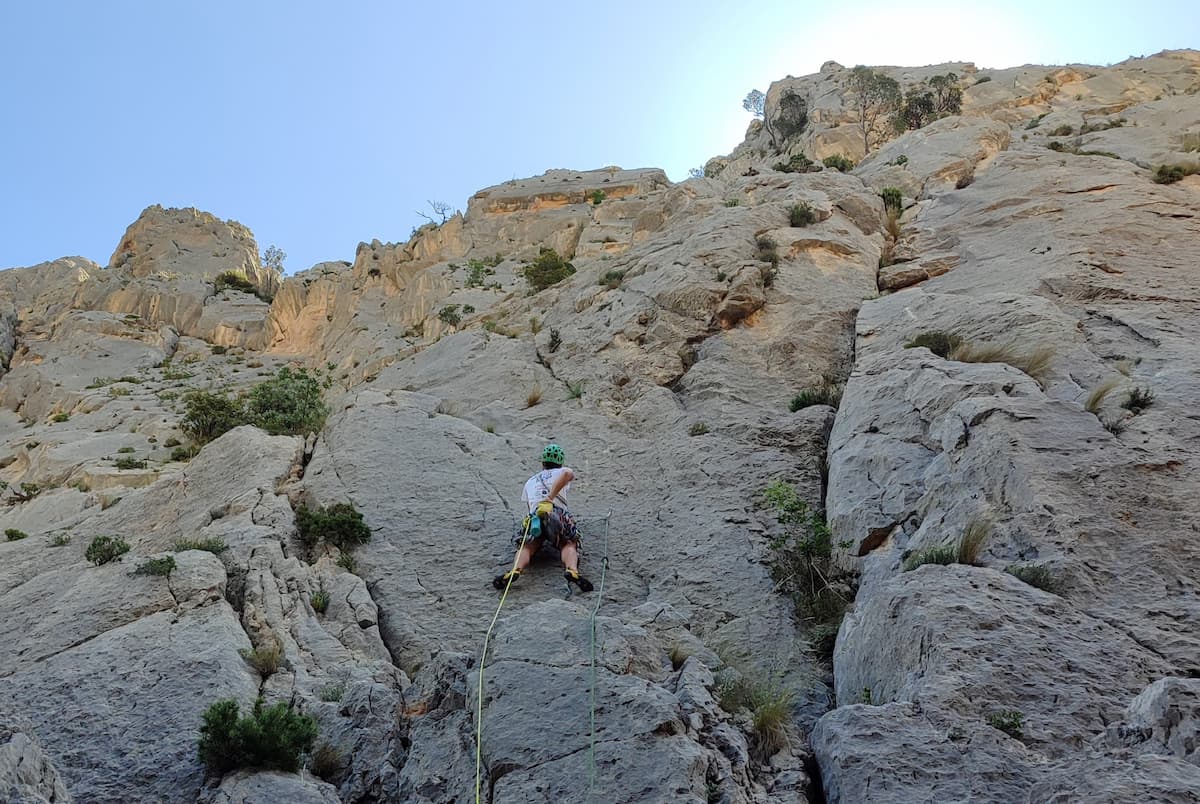
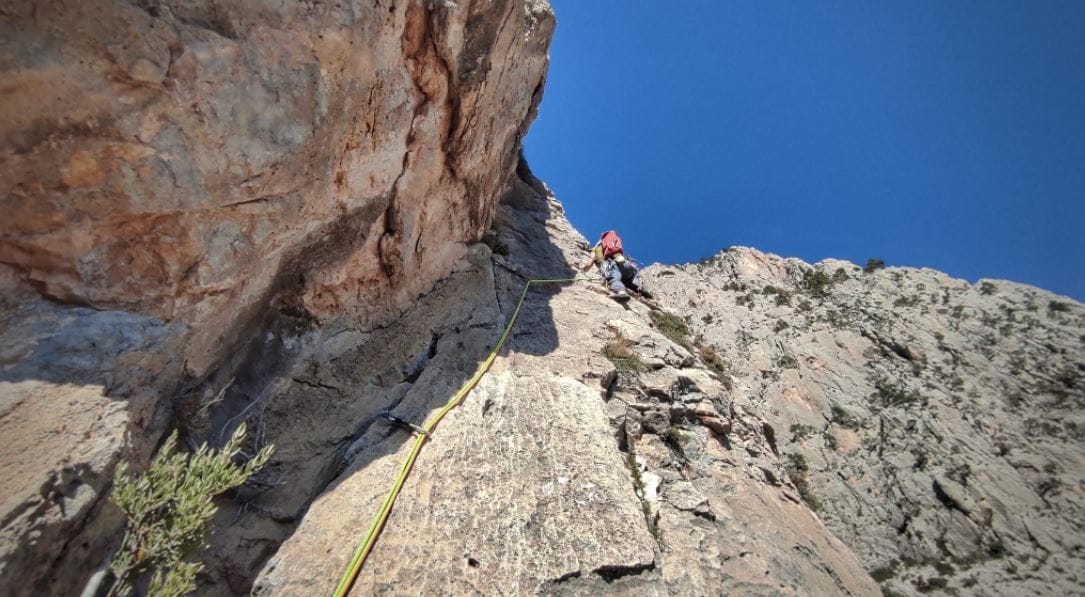
Want the detail, pitch by pitch? These route reports from our Spanish blog cover three Puig Campana classics with photos and topos:
Deep water soloing (psicobloc)
When summer heat closes the walls, the Costa Blanca offers an accessible place to climb above the sea without a rope. There are around 50 DWS routes, ranging from about 6 to 14 metres above the water, so this is a small, specialist activity.
| Area | Routes | Grades | Notes |
|---|---|---|---|
| Cueva Ambolo (Cova del Llop Marí), Jávea | about 18 | 6a to 8a+ | Sea cave. Routes listed at 9 to 12 m, with several 7c+ to 8a+ lines and one project |
| Illa del Descobridor, Jávea | about 12 | about 5 to 7a | Height about 8 to 14 m |
| Cala del Moraig, Benitatxell | about 16 | 5a to 7b | Three sectors, including El Farallón and Salto 12 m |
| Granadella, Jávea | about 7 | 6a+ to 7a+ | Short sector |
Some practical points:
- Season: June to October, when the sea is 22 to 26 °C. The water is cold from December to March.
- Cala Ambolo cove is closed. The cove has been officially closed for rockfall risk since about 2006 or 2007, with a vehicle barrier and warning signs. It is unclear whether climbers are exempt. The Xàbia Excursionist Centre re-equipped the rope routes in 2018 with a grant from the council’s sports department (42 active routes then, 45 on the council’s own tourism site), and a climber was rescued there in July 2024, so ask the council or the club before you go.
- Safety: check the sea state before you go, because swell makes landings dangerous. Look at the depth where you fall, wear a good water-entry technique and do not climb alone. Sea urchins and jellyfish are common. Use a local weather and marine forecast for tide and swell.
- Parking: parking at Cala del Moraig and Granadella is paid and capped in summer. Granadella has barriers once full, and the slipway is closed 1 March to 30 June for wildlife.
- Rules: as far as we know, no ban or permit rule for DWS applies in the Cap de Sant Antoni marine reserve, whose decree restricts anchoring, fishing and motorised sports. The Montgó Natural Park, however, bans sport climbing across the whole park (classic climbing is allowed only in the Cova Ampla area, with the director’s permission, and fixed gear was removed there in 2016), so do not assume DWS is allowed everywhere.
- Guides and topos: the Rockfax Deep Water guide (2007) covers Costa Blanca, and local psicobloc topos (the «PSICOBLOC Cabo de la Nao» guide) cover Moraig, Granadella and the Illa del Descobridor, while a free Ambolo DWS topo by Rich Mayfield of the Orange House circulates. Some walls are reached only by boat or kayak.
Contact the local professionals directly.
Bouldering
Bouldering on the Costa Blanca is a small but growing scene, with sandstone at Crevillent and a scattering of limestone areas. Counts vary widely, so use the numbers below as a guide to scale.
| Area | Problems | Rock and grades | Notes |
|---|---|---|---|
| Crevillent | about 445 | Sandstone, roughly 3 to 8C+, strongest at 6a to 7c+ | The best-established area. Autumn to early spring. Parking is tight and some access is uncertain |
| Elche | about 270 | Limestone, mainly 6c+ to 7c | Sectors include Cueva de al Lado and El Dorado |
| Moraira | about 60 | Limestone, 4A to 7A | Local topos are available |
| Racó de Cortés | about 40 | Grades vary from problem to problem | Marina Baixa area. Access is unclear, so ask locally |
| Xixona | about 35 | Laminated limestone, up to 8a+ | Hard, quiet, autumn and spring |
| Villajoyosa | about 30 to 45 | Sea-cave limestone, 5A+ to 8A+ | Includes the Cueva del Edwards |
| Dénia (Les Arenetes) | 25 or more | Limestone, 3+ to 7B | Best in autumn and spring. Vehicle access to the last stretch is restricted in summer, so check the dates |
Two cautions. Tormos was a good bouldering area, but it is now private property where climbing is currently not possible, so treat it as closed. And the dry river beds at Gata de Gorgos flood in autumn storms. Bring your own pads, and check the free local topos before you go.
Via ferratas
The province has several via ferratas, useful on a rest day or when the weather is poor for climbing. Grades are given in the K scale, and operators sometimes rate them differently.
| Via ferrata | Grade | Details |
|---|---|---|
| Xorret de Catí (Castalla) | K2 (K3 for some operators) | About 100 to 141 m, around 20 minutes of climbing, slightly overhanging at the start. Descend by two 25-metre rappels or an equipped channel |
| Ponotx (Polop) | K4 by operators | About 230 to 300 m, very exposed, with two rappels of about 25 and 35 metres, so bring a 70-metre or double rope. Notify the local police before and after, and carry federation licence or insurance |
| Callosa de Segura (Cueva Ahumada) | K3 section and a K5 sport section | The council gives 450 metres for the family section (K3, with a 26-metre wooden bridge and a 33-metre Tibetan bridge) and 685 metres for the sporting section (K5 per the council). Opened in February 2020 and free to use. Use is prohibited during storms |
| Penya del Figueret (Relleu) | K2 to K3 | About 50 m of vertical and a 150 m ridge, with a final rappel of about 27 to 30 m. June to November is the best season |
| Norte del Cid (Petrer) | K2 on paper | About 450 m with sections of IV and V climbing, so harder than the grade suggests. It is said to be the oldest via ferrata in the province, with a very thin cable and ageing gear, so check its condition before going |
Always carry a helmet, a harness and a via ferrata energy absorber with K carabiners, plus gloves and water. Do not use any via ferrata in a thunderstorm.
Rest days, rainy days and climbing gyms
The Costa Blanca is dry most of the time, but when a front rolls in or your skin needs a break, there is plenty to do.
- Caves: the Cuevas de Canelobre at Busot stay at a steady 17 to 18 °C, have a main vault about 70 metres high and are visited on a guided tour of about 45 minutes. They sit under the Cabeçó d’Or wall, so they fit a rest day there. The Cueva de las Calaveras at Benidoleig is another option.
- Via ferratas: fine on cloudy days, but not in storms (see above).
- Overhanging crags: Wild Side and VIPS at Sella, Cova de l’Aigua, El Rut and the Pinturas sector at Los Pinos are steep, but dry rock is never guaranteed.
- Indoor climbing: the regional federation lists 16 climbing walls in Alicante province, from Benidorm and La Nucía to Elche, Crevillent, Orihuela and Elda. The main commercial gyms are below.
| Gym | Town | Details |
|---|---|---|
| ClimbPro Center | Alicante | About 350 m² of wall, two bouldering zones, routes up to about 9 to 9.5 m, six auto-belays and a training board. Day entry was 10 euros and a month 55 euros on its published tariff |
| NYC (New York Climbing) | Elche | A commercial bouldering gym, open daily, with a day pass of about 12 euros for adults |
| Gravedad Zero | San Vicente del Raspeig | A bouldering gym in a unit of more than 380 m² with a small fitness area |
| Nanga Parbat | Alcoy | About 500 m² with a main wall 30 metres long and 4.5 metres high, a boulder zone and a café (check hours and prices) |
| Municipal walls | Elche (La Mano), La Nucía, Benidorm, Crevillent, Orihuela and others | Check hours and prices locally |
Rules, closures and ethics
Climbing on the Costa Blanca is free and generally unrestricted, but a growing number of crags have nesting closures, protected-area rules or access problems. These change, and the most useful sources are the Generalitat park pages and the FEMECV regulations finder. The table below summarises the position in October 2026. Always check again before you go.
| Area | Rule | Notes |
|---|---|---|
| Peñón de Ifach | North and north-west faces closed 1 April to 30 June. Ruta Roja descent needs a free reservation. No new routes | Park PRUG, Decreto 260/1993. South face open; the regulation asks climbers to inform the park |
| Serra Gelada | Ciutadella sector closed for nesting in winter and spring and needs prior authorisation. Other sectors need email notice. Maximum four climbers per sector. No new sport routes | Dates vary: the park gives 1 December to 30 June for Ciutadella, while federation regulations give 1 January to 30 June and can be read as applying to all three sectors. Check with serragelada@gva.es |
| Montgó (Dénia, Jávea) | Sport climbing banned in the whole natural park. Classic climbing allowed only at Cova Ampla with the director’s authorisation | Decreto 229/2007 |
| Morro de Toix (Calpe) | New routes banned. Climbing allowed only in three sectors (Candelabros del Sol, Piratas del Caribe and the west face of Racó del Corb, away from the south face). Federation regulations list Luces Nocturnas, Missing Link and all south-facing Racó del Corb routes for de-equipping | Flora microreserve (Order of 13 June 2001, with the 2009 ZEPA agreement). Local tourist information may still list some of the routes, so check federation regulations |
| Mascarat (Calp and Altea) | Climbing banned inside the microreserve except six listed routes (El Pajarón, Finis Africa, Sylphara, Flor de Gruta, Raúl Rodríguez, Vuelo del Águila) | Order 9/2020. Other fixed gear to be removed, and equipping or opening routes needs prior authorisation from the Alicante territorial directorate |
| Cabeçó d’Or (Busot) | Racó del Caldero sectors (Sherpa, Sherpita, Chorreras and others) reported closed from about 1 January (sometimes from 1 December) to 30 June for nesting | Dates may be revised in spring, so read the notice at the start of the path. Federation regulations only recommend avoiding the Desplome sector from January to June |
| Redován | Botri banned all year. Local signs are reported to ban Botri and Los Cortaos January to June | Decreto 174/2010 |
| Cueva Ahumada (Callosa de Segura) | Pared del Rabosero closed 1 January to 31 July. Authorisation needed for about a dozen listed routes from 1 August to 31 December | Microreserve: Order 11/2010. Paraje natural municipal: agreement of 30 September 2005 |
| Rincón de Bonanza (Orihuela) | Many routes banned all year, a few banned 1 March to 30 June, and equipping needs authorisation | Order 9/2020. Check the route-by-route list |
| Petit Ponoig (Orihuela) | Banned 1 December to 30 June for nesting | Not the same place as the Ponoig at Polop |
| Salinas, Agujas Rojas (Onil) | Closed in spring: about 1 March to 1 June at Salinas and March to June at Agujas Rojas (federation regulations) | Dates vary from year to year |
| Aixortà | No new bolting. About 20 routes were removed in 2022 | Agreement of 6 May 2022 |
| Sax (Cabreras) | Reported banned since November 2024 by new landowners | Check with the local club. Federation regulations also list a January to June restriction on the summit walls |
| Alcalalí, Murla and Murlalí (Serra Seguili) | Reported closed all year by the three councils after archaeological finds | Treat as closed unless confirmed reopened |
| Tormos (bouldering) | Private property, currently not climbable | Treat as closed |
| Cala Ambolo cove | Closed for rockfall risk, with gates and signs | Unclear whether climbers are exempt |
General rules
- Drones: a Valencian regional resolution of 5 February 2025 does not allow drone flights, recreational or otherwise, inside natural parks and other protected natural areas. Only public bodies and professionals with justified work can be authorised. Do not fly a drone inside any park.
- Fire: open fires are banned in the parks and in forest land. At the highest wildfire preemergency level (level 3) the Generalitat also closes forest tracks and paths in a list of parks. On 19 to 21 August 2026 this covered 13 parks, including Penyal d’Ifac, Serra Gelada and Montgó.
- Camping and bivouac: free camping is banned in the natural parks. Bivouac at Serra Gelada needs a declaration filed with the park 30 days ahead.
- Dogs must be on a lead in the parks.
- Bolting: new routes are banned at Ifach, Serra Gelada (sport), Morro de Toix, the Cueva Ahumada microreserve and several other places. Do not add or move bolts, and do not chip holds. Where re-equipping is allowed, it usually needs authorisation.
- Nesting: if you find a nest on a route, come down and warn others. Respecting short closures is what keeps them short.
- Parking and fruit: park only where allowed and never block farm gates, and do not pick the farmers’ fruit.
Safety, insurance and emergencies
- Emergencies: dial 112. The provincial fire brigade runs a special rescue group (the GER, set up in 2005) with a helicopter, which handles mountain rescues in Alicante province, including cliff rescues at Toix. It is unclear whether rescues are charged to the person rescued in the Valencian Community, so do not assume they are free.
- Insurance: the European Health Insurance Card (EHIC) or the UK GHIC only gives access to state healthcare. It does not cover mountain rescue or repatriation, so you need travel insurance that explicitly covers climbing.
- FEMECV cover: the regional mountaineering federation sells licences and short-term accident insurance. In 2026 a weekend policy (two consecutive days) was listed at 7 euros and a seven-day policy at 16 euros, covering accident, civil liability, emergency care and, after a sporting accident, search and rescue costs, for climbing, via ferratas and canyons, valid in Spain only. The federation sets no residency requirement, but the policy has to be arranged in advance, so allow several days and contact the federation first.
- Common hazards: polished classics, old fixed gear on the older routes, loose rock and wide bolt spacing at Toix, long descents and early darkness on the Puig Campana, flash floods in dry riverbeds in autumn, and sudden wildfire closures in summer.
- Heat: from May to October start early, carry plenty of water and choose shade.
A short history of Costa Blanca climbing
- 1950s: local climbers start on the Peñón de Ifach, and the Pany (1955) is the first route on the rock. Valencianos follows in 1958.
- 1960s and 1970s: mountain classics arrive. Climbing at the Puig Campana begins in the 1960s, the first route on the Ponoig falls in 1970 to two British climbers, and the Espolón Central is dated between 1962 and 1966 by most guides and to 1970 by Miguel Gascón, one of the party. Gene on the Cabeçó d’Or is climbed free in 1974, and the Diedro UBSA at Ifach in 1977.
- 1980s: sport climbing begins. The first bolted routes appear at Toix, Sella, Alcoy and Alcalalí, helped by a wave of foreign climbers, and the Edwards brothers start to equip and explore.
- 1990s: the Costa Blanca becomes one of Europe’s leading winter sport-climbing destinations. Wild Side at Sella opens in 1992, a refuge opens in 1993, cheap flights to Benidorm and Alicante bring British and Northern European climbers, and the first widely used English-language guidebook, by Chris Craggs, appears in 1989 or 1990.
- 2000s and 2010s: Cabeçó d’Or’s tufas, Penya Roc and Aixortà are developed. The land above La Moleta at Sella changes hands in 2013 and its new owners reopen the cliffs, and the new Cala Ambolo routes are re-bolted in 2018.
- 2020s: closures and regulation increase, Aixortà reopens after a ban, the Callosa de Segura via ferrata opens in 2020, and a new version of the federation’s regulations finder is launched in October 2025. A new, fully revised Rockfax edition arrives in March 2026.
Guidebooks and apps
- Rockfax, Costa Blanca (Chris Craggs and Alan James, 2026 edition): the English-language standard for sport crags, covering around 50 crags from Murcia to Gandia, with more than 4,800 routes. A digital version exists.
- Costa Blanca Climbs (Roberto López, 2nd edition, 2025 to 2026): a bilingual guide to 56 crags and more than 4,000 sport routes, from Gandia to Orihuela.
- Escaladas Alicante (Ediciones Desnivel, revised 2nd edition, 2024): more than 3,000 routes at 27 crags west and north of Alicante city.
- Costa Blanca Mountain Adventures (Mark Eddy, Cicerone, 2022): ridge scrambles, via ferratas and other multi-activity days, including the Bernia, Toix and Benicadell ridges.
- Older Spanish-language guides: Manolo Pomares and Carlos Tudela for the Puig Campana, and a federation guide to the Peñón de Ifach.
- Apps and sites: theCrag, theTopo, MadBoulder for bouldering, and the regulation tools of the regional federation.
Sample itineraries
One week of winter sport climbing
- Day 1: Sierra de Toix or Olta for a warm-up on easy routes and views of the sea.
- Day 2: Sella, La Moleta zone, for the classic Costa Blanca sport day.
- Day 3: Guadalest and Echo Valley, an easy day on friendly rock.
- Day 4: Rest day: Canelobre caves or a via ferrata.
- Day 5: Llíber or Garx in the Jalón valley.
- Day 6: Mas de la Penya or La Basseta near Alcoy.
- Day 7: Sella again, Wild Side or Rosalía if you are strong, or a last easy day at Toix.
One week of big days and sea views
- Day 1: Valencianos or Pany (outside the closure) on the Peñón de Ifach, with the Ruta Roja reservation booked.
- Day 2: Toix Ridge or sport at Toix.
- Day 3: Espolón Central on the Puig Campana, with a headtorch.
- Day 4: Rest day, or the Ponotx via ferrata.
- Day 5: Vía Gene on Cabeçó d’Or, or the Cresta de Bernia.
- Day 6: A sport day at Sella to recover.
- Day 7: Valencianos on the Ponoig if you have the experience, or an easy day at Guadalest.
A summer trip
Climb at dawn on Foradà’s north face, Aixortà or Wild Side, and spend the middle of the day in the sea. Add a deep water soloing day at Cala del Moraig or Granadella, and avoid the south faces and the polished Ifach classics in the heat.
Climb the Costa Blanca with a certified local guide
With dozens of crags, big mountain days, closures that change every season and polished classics that look easy on paper, local knowledge is the difference between a good trip and a great one. A certified guide can lead your first multi-pitch on the Peñón de Ifach, keep the timing honest on the Puig Campana, run a lead-climbing or self-rescue course at Sella, or point your week in the right direction as the weather and the closures move. Guided climbing days typically cost 150 to 250 euros for one or two people, and several guides in our directory work the Costa Blanca all year and speak English.
Tell us your dates and level, and climb the Costa Blanca with a local guide
Frequently asked questions
What is the best time of year to climb on the Costa Blanca?
October to April is the main season, and November to March is the sweet spot for sunny south faces. Spring and autumn are ideal almost everywhere. In summer the game changes: climb at dawn on north faces, or go deep water soloing.
How many climbing routes are there in Alicante province?
Several thousand. The main English-language guidebook covers about 50 crags and more than 4,800 routes, and local guides add more. Sella alone has roughly 500 routes, and multi-pitch routes, boulders, deep water solos and via ferratas come on top.
Do I need a car?
For almost every crag, yes. The TRAM and coaches link Alicante, Benidorm, Altea and Calpe, which is enough to reach the Peñón de Ifach, but Sella, the Puig Campana, the Jalón valley, Alcoy and the Vinalopó crags need a hire car.
Is the Peñón de Ifach open for climbing all year?
The south face is not banned, but the north and north-west faces are closed every year from 1 April to 30 June for peregrine falcon nesting. The Ruta Roja descent needs a free online reservation, and new routes are forbidden.
Which crags are best for beginners?
Guadalest, Echo 1.5 in Echo Valley, La Basseta and Barranquet del Ferri in Alcoy, the «La Escuela» sector at Callosa de Segura, and the lower grades of La Moleta at Sella. Many climbers also start with a guided course.
Where can I find easy multi-pitch routes?
The Pany and Valencianos at the Peñón de Ifach, the Vía Gene on Cabeçó d’Or, the Cresta de Bernia and the Espolón de Pared Negra are the usual first choices. The Espolón Central on the Puig Campana is only grade V but a long mountain day, so go with experience or a guide.
Is deep water soloing legal on the Costa Blanca?
There is no general ban, but the rules depend on the place. Cala Ambolo is closed for rockfall risk, the Montgó Natural Park bans sport climbing, and sea-state and swell risks are real. Ask locally, and never solo above water without checking the depth and conditions.
Can I climb on the Costa Blanca in summer?
Yes, but pick carefully: shaded north faces such as Foradà, Aixortà, Castellar and Wild Side, early starts, and deep water soloing. Avoid south faces in July and August, when highs reach 30 to 31 °C on the coast.
Do I need insurance to climb on the Costa Blanca?
Yes. Your European or UK health card covers state healthcare but not mountain rescue, so you need travel or climbing insurance. The regional federation sells short-term accident insurance, but ask whether it is open to visitors.
How much does a guided climbing day cost?
Typically 150 to 250 euros per day for one or two people, and courses cost less per person in a group. Contact us with your dates and level to be matched with a local certified guide.
Useful links
- Peñón de Ifach climbing guide and Puig Campana climbing guide
- Climbing guides in Alicante (profiles in Spanish, several guides speak English)
- Climbing courses in Alicante
- More climbing destinations in Spain