
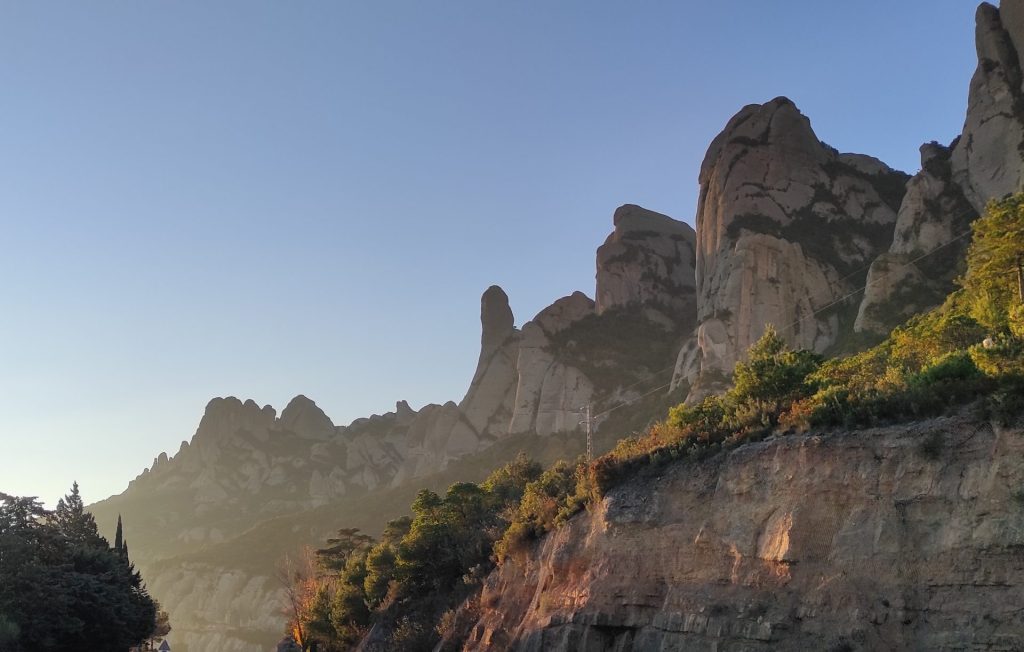
Climbing in Montserrat means fine conglomerate on a massif of nearly 1,500 needles and several thousand routes, less than an hour from Barcelona. Multi-pitch is the soul of the place, split between adventure climbs and better equipped lines, with the unmistakable spire of the Cavall Bernat as its symbol. Few skylines in the climbing world are as recognisable as this one, and few areas offer what has become rare: real summits, small and airy, that you reach pitch by pitch.
- Location: Montserrat massif, Barcelona province, Catalonia.
- Rock: fine conglomerate (pudinga).
- Altitude: summits up to 1,236 m (Sant Jeroni).
- Style: multi-pitch above all, plus bolted sport sectors and bouldering.
- Scale: ~1,500 needles, thousands of routes.
- Best season: autumn, winter and spring; shade-hunting in summer.
The rock and the style
Montserrat’s conglomerate is made of small rounded pebbles (nothing like the fridge-sized cobbles of Riglos) set in a cement of superb quality. It produces a very particular kind of climbing that locals call the «finura montserratina»: technical, balancy, and built on trusting the rock under your feet. Three worlds coexist here:
- Multi-pitch, the essence of the school: routes up the needles with variable equipment. Many classics carry fixed gear (often old) and equipped belays; others demand your own protection. Expect airy, sometimes committing terrain.
- Sport climbing: fully bolted sectors, good both for starting out and for pushing your grade.
- Bouldering on conglomerate at sectors like Guilleumes or the Torrent de la Salut.
Grades run from friendly IV and V to serious test-pieces, but treat Montserrat grades with respect: on the adventure classics the gear can be old bolts or pitons, the exposure factor is real, and a «moderate» grade can still demand a cool head.
Classic routes, wall by wall
Out of thousands of routes, this is the shortlist of essential classics with length and grade. A0/Ae means a point of aid. For a first taste, look for the well-equipped lines: Rataplan, Montpart, the Cavall Bernat Normal or The Wall.
Cavall Bernat, the jewel
- Vía Normal, 80 m, V+.
- Puigmal, 250 m, V+/A0.
- Punsola-Reniu, 250 m, 6c.
- La Gran Il·lusió, 230 m, 7a.
Sant Benet (la Prenyada)
- Cerdanyola, 70 m, V+ · Esperó Màgic, 100 m, V+ · Gómez-Xalmet, 120 m, V/A0 · Redimonis, 110 m, 7a.
L’Elefant and La Momieta
- The Wall, 125 m, V · Vía del Jan, 100 m, 6b · Elefanta Elena, 135 m, 6b.
- La Momieta: Vía Normal, 80 m, V+ · Haus-Estrems, 150 m, 6a · Kung Fu, 130 m, 7a.
Gorros zone (Magdalenes and Gorro Frigi)
- Rataplan, 100 m, V- · Montpart, 180 m, IV · Vía del Carles, 160 m, V · Ignasi Jorba, 130 m, V+ · Amistat d’Estiu, 130 m, 6a.
Ecos and Roca de Pobent
- Francesc Casanovas, 155 m, 6a · Viatge Apatxe, 105 m, 6b · Animistes, 100 m, 6b+ · Plecs del Llibre, 205 m, 7a.
The big walls
- Serrat del Moro (Santa Cecília): Casas-Chani, 280 m, V+/A0 · Mas-Brullet, 290 m, V+/A1, ideal for learning crack climbing.
- Torrent del Migdia: Sagitario, 180 m, 6a/A0 · Aresta Arcarons, 200 m, 6a+, one of the most beautiful ridges of the massif.
- Els Frares Encantats: Esperó Ribas, 195 m, V+/A0 · Anglada-Cerdà, 255 m, V/A2 · GAM (el Bisbe), 230 m, 6c.
- Paret de l’Aeri: Easy Rider, 300 m, V+ · Valentín Casanovas, 300 m, 6a/A0 · Fraggel Rock, 280 m, 6b.
- Paret dels Diables: Rolling Stones, 160 m, 6a/A2 · Sánchez-Martínez, 330 m, V+/A0 · Vía GAM, 300 m, V+/A0.
- Diedre CADE (Serrat del Centenar): 200 m, V+/A0, the definitive Montserrat dihedral · Anglada-Cerdà, 170 m, V+/A2.
The Cavall Bernat
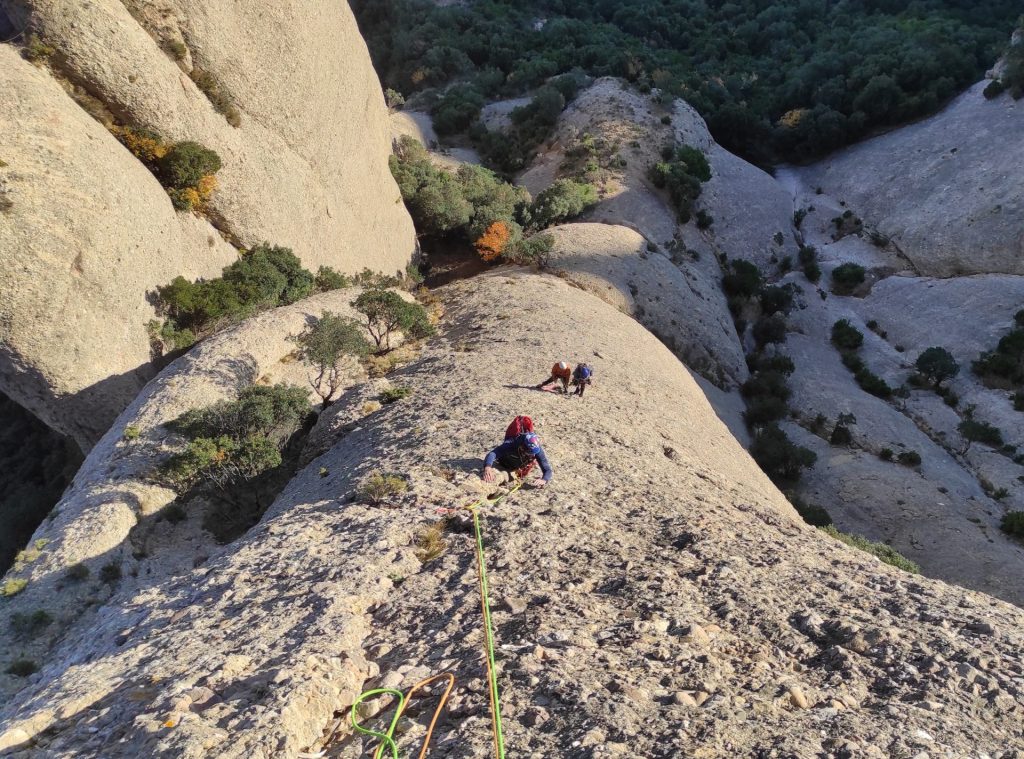
No needle represents Montserrat better than the Cavall Bernat, first summited in 1935 and wrapped in stories ever since. Its Vía Normal (V+, about 80 m) is short but wildly airy, a dream objective for generations of climbers. For a bigger day, the Punsola-Reniu (6c, about 250 m) climbs the north face in a string of exposed pitches and stands among Montserrat’s greatest classics. For many climbers, standing on that summit block is the climb of their life.
Contact the local professionals directly.
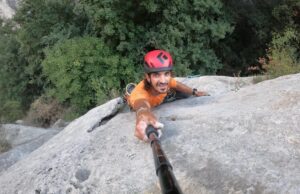
Season
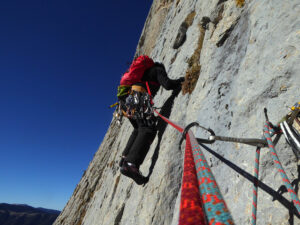
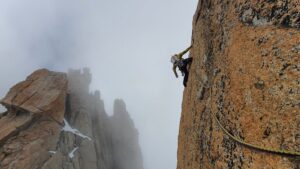
A low and mid-altitude mountain, Montserrat is an autumn, winter and spring destination. Autumn and spring are probably the sweet spots; winter is excellent on the sunny faces on clear days; summer works if you chase the shady walls and the cooler hours. Check the forecast either way: fog and wind can transform a Montserrat day.
Getting there and planning your visit
- Access: under an hour from Barcelona by road, entering from Monistrol de Montserrat, El Bruc or Collbató depending on the zone. You can even arrive by train and rack railway to the monastery, which makes Montserrat one of the few world-class areas reachable without a car.
- Where to stay: the villages around the massif (Monistrol, El Bruc, Collbató) or Barcelona itself.
- How long: Montserrat is a lifetime project. For a first visit, a day in the Agulles region or an equipped sector like Can Jorba or Gorros is ideal; with several days you can mix classic needles, long routes and the Cavall Bernat.
- Local advice: carry a good topo and study the approach (it is genuinely easy to get lost among so many needles), start early in the warm months, and respect what is both a natural park and a place of deep cultural value. Watch for seasonal bird-nesting restrictions on some walls.
Gear
- Sport sectors: rope, quickdraws and helmet; a 70-80 m rope is useful on the longer pitches.
- Multi-pitch: add a set of nuts and a few cams for the semi-equipped routes, long slings, belay and abseil material. Double ropes recommended.
- Helmet always: conglomerate can shed loose stones.
Ask about upcoming courses and guided days with certified guides.
Beyond the climbing
Montserrat is a first-order cultural destination: the Monastery with the Moreneta is one of Catalonia’s great pilgrimage sites, the hiking network is superb with the ascent of Sant Jeroni (1,236 m) as the classic, and the rack railway and funiculars make a perfect rest-day plan to pair with a day on the rock.
Climbing Montserrat with a certified guide
Montserrat is a dream destination and a labyrinth: needle climbing and adventure routes demand experience, orientation and solid rope work. A certified local guide picks the right region and route for your level, whether that is your first long route, your first summit needle, or the Cavall Bernat itself, and turns a confusing maze of rock into the best climbing day of your trip to Barcelona.
Climbing near Barcelona? Tell us your plan and climb Montserrat with a local guide
Useful links
- Climbing guides in Montserrat (profiles in Spanish, several speak English)
- More climbing destinations in Spain